Backend Development
Backend Development Services
I provide backend development services to startups, SaaS teams and businesses that need reliable server-side logic, secure APIs and databases built for real traffic. As a back-end developer. Specializing in back-end development and back-end web design.
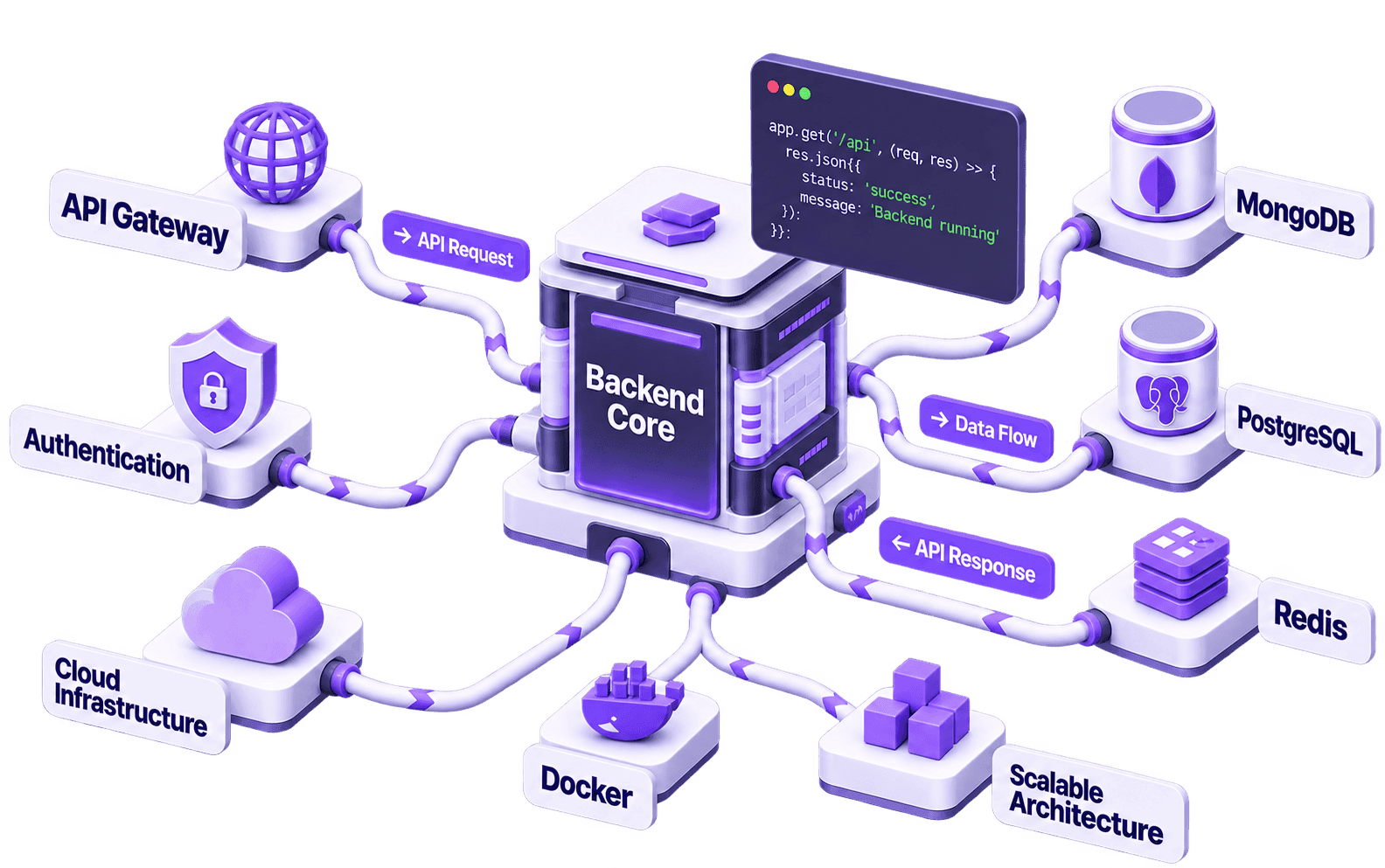
Backend Development architecture visualization
In scope
Backend Development
- 01 coveredNode.js & Express.js Development
- 02 coveredAPI Development & Integration
- 03 coveredDatabase Development & Design
- 04 coveredBackend Architecture & Microservices
- 05 coveredCloud, DevOps & Deployment
5 areas covered
What Backend Development Includes
Backend development means building everything that runs behind the scenes of an application: the server logic, the database layer, and the APIs that connect them to the interface a user sees. Good server-side development stays invisible when it works well. Requests get validated, business rules run in the right order, and data comes back accurate and fast. I treat backend software development as its own discipline, with its own software architecture decisions, not something bolted onto the frontend after the fact.
Underneath the application logic sits the infrastructure that keeps a backend running. Cloud backend development, Docker development, and CI/CD development work together so updates ship without downtime and the system recovers on its own when something fails. None of these pieces change how your product behaves. They exist so backend infrastructure stays available as usage grows, whether that growth happens over a year or over a weekend.
Every request that reaches the backend passes through validation, authentication, and business logic before it ever touches the database. This layering is what keeps backend systems stable: the API can change without breaking the database, and the database can be optimized without breaking what the frontend expects.
Application backend work is not just business logic either. Web server development and backend infrastructure decisions, like caching, queues, and load balancing, are what keep server-side applications responsive once real users arrive, and what most backend development services quietly depend on.
What makes this backend development service different?
- Custom backend development built around your actual product, not a template
- Secure backend development with authentication and validation handled from day one
- Backend engineering services covering APIs, databases, and deployment together
Leverage End-to-End Backend Web Development Services
So here’s the full scope of backend web design work that I do, broken down by what each piece actually entails.
- 01
Node.js & Express.js Development
Node.js handles concurrent requests well, which is a big part of why I default to it for most backend builds. Combined with Express.js, it gives me a fast, flexible foundation for REST APIs, real-time features, and the server-side logic your app runs on. It also scales without much drama. A Node.js backend built right won't fall over just because your user count jumped from 500 to 5,000 overnight.
- 02
API Development & Integration
Almost every project starts here. API development is the layer that connects your frontend, your mobile app, and any third-party service to the data and logic running underneath.I build REST APIs when things need to be predictable and GraphQL APIs when clients need flexible requests for specific data. Either way, I document the endpoints thoroughly to ensure your frontend team knows exactly what a response looks like, so they aren't guessing.
- 03
Database Development & Design
Bad database design is the single most common thing I get called to fix. Slow queries, duplicate data, and missing indexes are all common problems, but they are symptoms of a schema that was never meant to scale. It all traces back to a schema that was never planned for scale, which is the root cause of all these issues. for scale.I design schemas around how your app actually queries data, not just how it stores it.
- 04
Backend Architecture & Microservices
Not every product needs microservices. Some genuinely just need a clean monolith. I pick the architecture based on what your team can actually maintain, not what sounds impressive on a slide.That said, when a product does need to scale independently across services, I build it that way from the start, so you're not rebuilding the whole thing at 100,000 users.
- 05
Cloud, DevOps & Deployment
I deploy to AWS most often, though the platform depends on your existing setup. Docker keeps environments consistent between my machine, staging, and production, and CI/CD pipelines mean a code push doesn't require someone manually SSHing into a server at 11pm. Cloud backend development is really about not thinking about servers. Traffic spikes. Your infrastructure handles it.
- 06
Backend Security & Performance
Security gets bolted on at the end far too often. I don't do it that way. Authentication, input validation and rate limiting: these get built alongside the feature, not added after a security audit flags something.Performance works the same way. I profile queries and API response times during development, rather than waiting for a customer to complain that the dashboard takes 8 seconds to load.
- 07
SaaS & Enterprise Backend Systems
SaaS backends have their own set of headaches: multi-tenancy, billing logic and role-based permissions across dozens or hundreds of accounts. If the data isolation is not implemented correctly, it can lead to significant issues rather than just a minor bug.I've built these systems with that in mind from the schema level up, so one customer's data never leaks into another's view by accident.
- 08
eCommerce, Marketplace & Portal Backends
Checkout flows, inventory, payment processing and admin dashboards. eCommerce backend development touches real money, so error handling has to be thorough, not an afterthought.Marketplace and portal systems add another layer: multiple user types with different permissions all hitting the same backend.
- 09
Third-Party & System Integrations
CRMs, ERPs, payment gateways and whatever tools your business already runs on. I connect them to your backend so data flows between systems instead of getting re-entered by hand three times.Third-party APIs change without warning more often than you'd think. I build integrations that fail loudly and alert someone, instead of silently dropping data for two weeks before anyone notices.
Common Backend Development Challenges I Solve
Here's the thing: most people don't hire a backend developer preemptively. They hire one after something breaks. These are the problems I see most.
Slow, Unpredictable APIs Under Real Traffic
An API that responds in 100ms during testing can crawl to 3 seconds once 500 real users hit it at once. I investigate query performance, caching, and server configuration to identify the root cause of the bottleneck, and address it directly, rather than just treating the symptoms.
Databases That Were Never Designed for the Product
This happens constantly. A schema gets thrown together to ship an MVP, the product succeeds, and two years later that same schema is choking under data it was never designed to hold. I redesign these without taking your live product offline.
Backend systems lack a clear architecture
Features For years, developers have added features without a clear plan, leading to a system that nobody fully understands. For years, developers have added features without an overall plan, resulting in a system that nobody fully understands. I map the whole thing out first, then refactor toward something documented and sane.
Broken or Fragile Third-Party Integrations
The scariest kind of bug is the one that fails silently. An integration breaks, nobody notices for a week, and now there's a pile of unsynced data to untangle. I rebuild these with proper logging and alerts.
No In-House Backend Expertise
Plenty of businesses don't need a full-time backend hire; they need someone dedicated for a specific project. I step in as the dedicated person for the specific scope you need, without taking on any additional responsibilities.
Security Gaps Found Too Late
Most security gaps I find weren't caused These gaps were not caused by carelessness; rather, they resulted from a lack of time for thorough investigation. I run through authentication flows, data handling, and API access before that gap turns into an actual incident.
How I Approach Backend Development
I follow a consistent process on every project. It keeps timelines honest, and makes sure something critical doesn't slip through because I moved too fast.
Discovery & Requirements
Before any code, I need to understand your product, your users and the problem you're trying to solve. I would like to learn more about your product, your users and the specific problem you are aiming to address. This phase may seem tedious, but neglecting it often leads to project complications.
API Architecture & Planning
I map out endpoints, data flow, and how the frontend, and backend will talk to each other, so nobody's guessing mid-build what a response should look like.
Database Design & Modeling
Schema design happens here, along with figuring out which queries the app will run most and how the data relationships actually work.
Core Backend Development
Backend development is the bulk of the work: business logic, server routes, and the actual functionality your product needs to run.
Integration & Third-Party APIs
Whatever external services your product depends on, payment processors, CRMs or whatever, get connected and tested here.
Security & Testing
Before anything ships, I test for bugs, security holes and how the system behaves under realistic load, not just a happy-path demo.
Cloud Deployment & CI/CD Pipeline
Your backend is deployed on your preferred cloud platform and CI/CD is configured for safe automatic deployment of future updates.
Launch & Ongoing Support
After launch I stick around. Monitoring, bug fixes and updates as your product changes, because a backend is never really "done."
Technologies Used for Backend Development
I don't default to the same stack for every client, though. The right tools depend on your data, your traffic patterns, and what your team can maintain after I'm gone, so I pick based on that, not habit.
Runtime & Frameworks
- Node.js
- Express.js
- NestJS
APIs & Communication
- REST APIs
- GraphQL
- WebSockets
Databases & Caching
- PostgreSQL
- MongoDB
- MySQL
- Redis
Cloud & DevOps
- AWS
- Docker
- CI/CD
How I Build Backend Systems
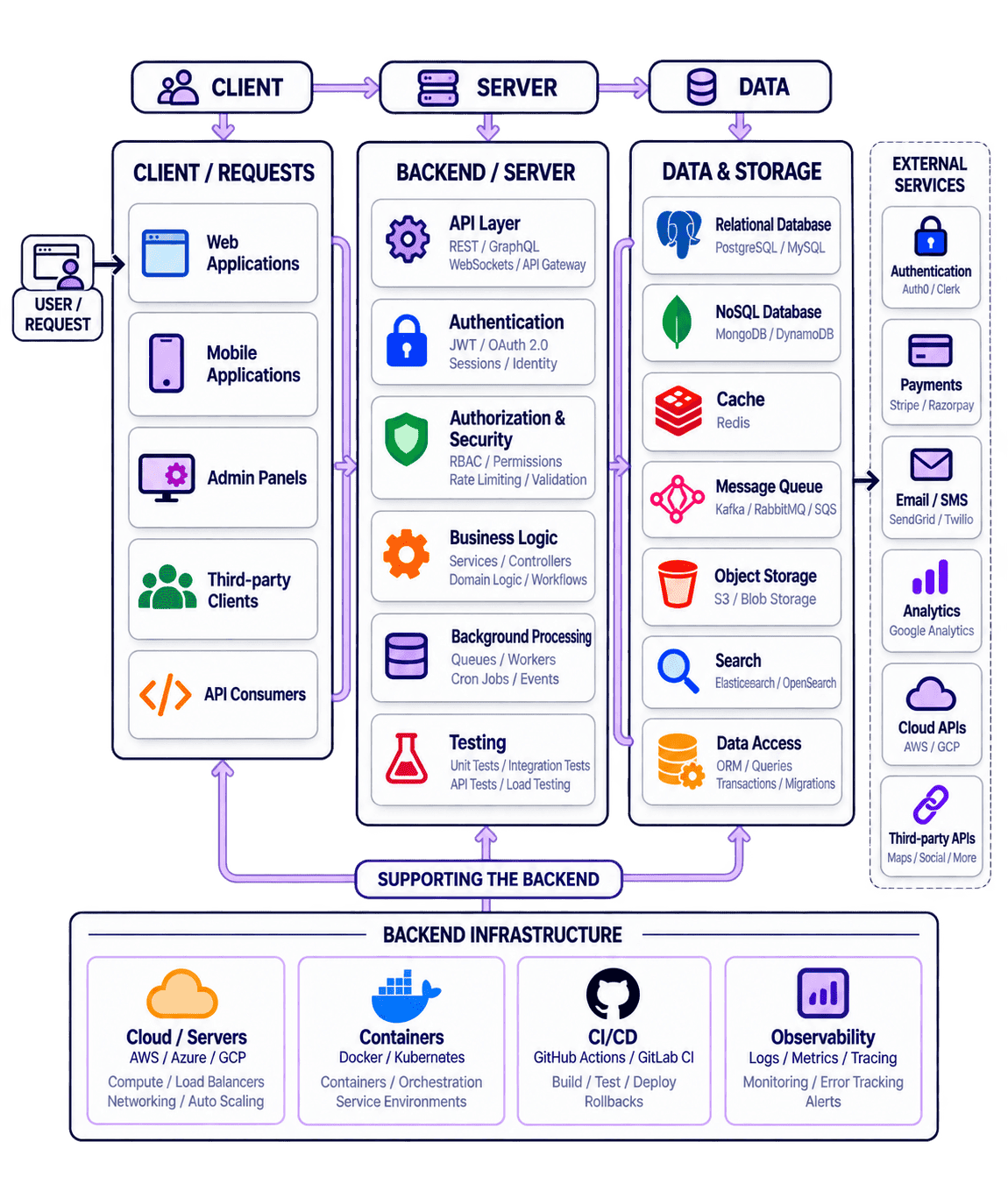
A backend system is more than one server responding to requests. Here is how the backend components actually work together once an application is live, not just the steps used to build it.
Every request that reaches the backend passes through validation, authentication, and business logic before it ever touches the database. This layering is what keeps backend systems stable: the API can change without breaking the database, and the database can be optimized without breaking what the frontend expects.
Application backend work is not just business logic either. Web server development and backend infrastructure decisions, like caching, queues, and load balancing, are what keep server-side applications responsive once real users arrive, and what most backend development services quietly depend on.
Logging and monitoring run across every layer at once, so if a database performance optimization issue starts building, it shows up on a dashboard before users notice anything is wrong.
None of these layers work in isolation either. A change in backend architecture affects how the database gets queried, how the API responds, and how the whole system holds up once real traffic replaces test data. This is why backend systems built without a clear structure tend to break under load first, not because the code is wrong, but because nobody planned for how each layer depends on the ones around it.
Where this shows up
- SaaS Products
- eCommerce Platforms
- Dashboards & Portals
- Fintech & Healthcare
Backend Development system architecture architecture visualization
Backend Development Use Cases
Backend development shows up in almost every kind of product. Here's where I've spent the most time building.
SaaS Products
Billing logic, user roles, data isolation between accounts. SaaS backends need all three handled correctly from the start, not patched in later.
eCommerce Platforms
Product catalogs, checkout, payment processing, all of it needs to hold up during a Black Friday traffic spike, not just a quiet Tuesday.
Dashboards & Portals
These live or die on query speed. I optimize the backend so data loads fast even as the dataset grows.
Fintech & Healthcare
More attention to encryption, access control and compliance. These industries don't leave much room for "we'll fix it later."
Internal Tools
Internal tools are often overlooked, but they still require a reliable backend that won't fail. I keep these lean and reliable without over-building them.
API-First & Integration Platforms
Some products are the API. I build backend systems around API architecture and integration from the ground up, for businesses whose product is what other companies connect to.
Who My Backend Development Services Are For
Startups, growing companies, and established businesses all end up here for different reasons. Here's how that usually breaks down.
Startups Building Their First API
If this is your first backend, I help you build something solid without over-engineering a v1 that doesn't need to handle a million users yet.
Growing Businesses Outgrowing No-Code Backends
At some point, Bubble or Airtable stops scaling. I move you to a custom backend built for the volume you're actually dealing with now.
Enterprises Needing Reliable Systems
Larger organizations need backend systems tested thoroughly, secured properly and built to meet strict uptime expectations.
Companies Looking to Hire Without a Full-Time Role
If you don’t have yet the budget for a full-time backend developer, I can give you focused backend development for the specific needs of the project.
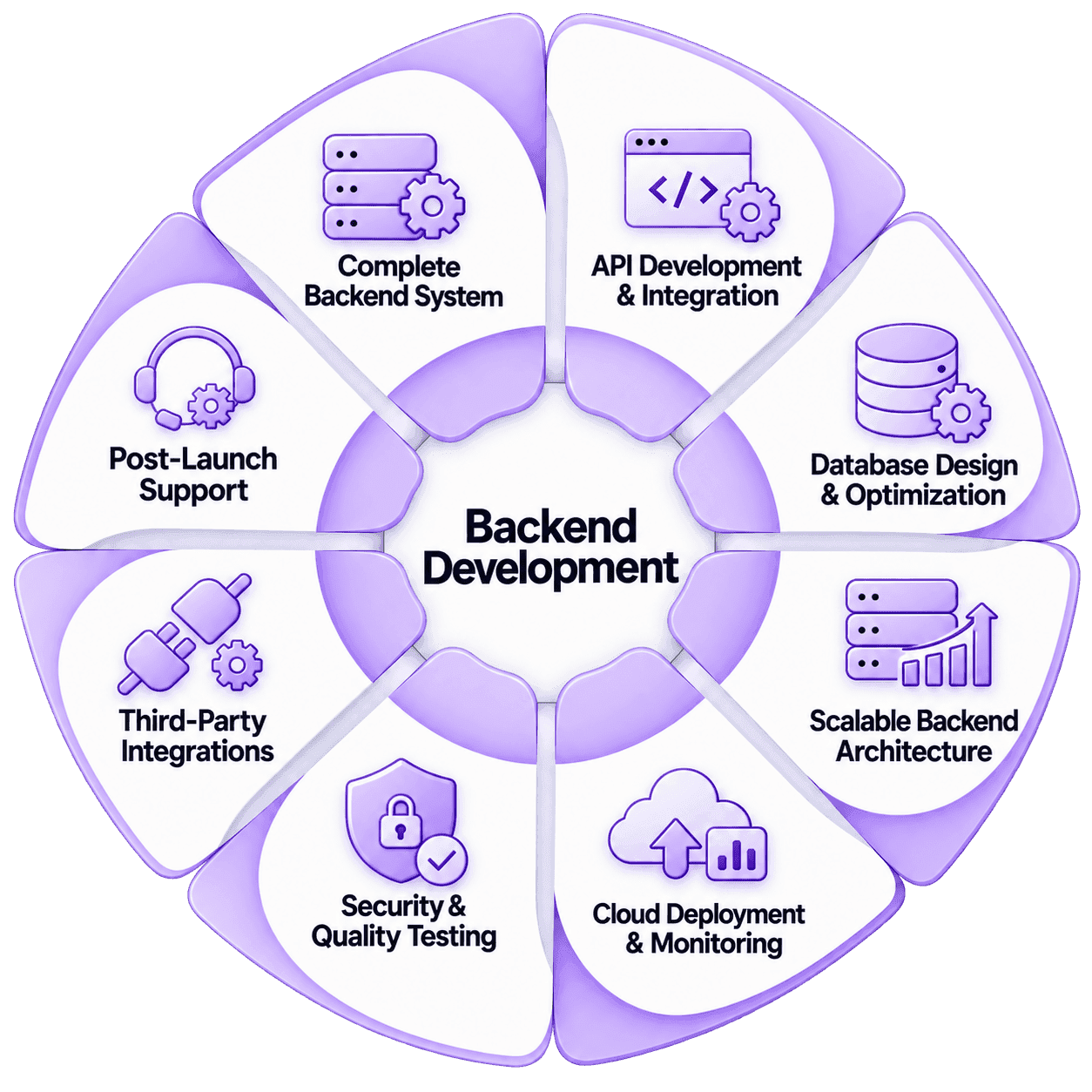
What's Included in My Backend Development Services
Every engagement comes with more than just code dropped into a repository. Here's what's actually delivered.
Complete Backend System
The full backend: business logic, server setup, and every core function your application needs to actually run.
API Development & Integration
Custom REST or GraphQL API’s, and integration with any 3rd party services your product depends on.
Database design and optimization
A schema tuned for your actual data and query patterns, not some generic template.
Scalable backend architecture
A scalable architecture that can accommodate growth in users, and data without rebuilding from scratch.
Cloud deployment and monitoring
You can deploy to your preferred cloud platform, and basic monitoring will alert you when something needs attention before a user reports it.
Security and Quality Assurance
I check Authentication, data handling, and API endpoints. before anything goes live.
Third-Party Integration
Payment gateways, CRMs, ERPs and any other tools that your business already uses are integrated. I connect them so your backend isn't operating in isolation.
Post-Launch Support
This includes bug fixes, updates and help keeping the backend current as your product develops, even after the initial build is finished.
Benefits of Backend Web Development
When a backend is done right, it changes how the entire product operates, not just how it looks on a spec sheet.
- Benefit
Faster APIs
Fast loading pages from optimized queries, and clean backend code mean users stick around rather than bounce waiting.
- Benefit
Fewer Outages
A backend architected well handles traffic spikes, and errors without taking the whole app down with it.
- Benefit
Lower Long-Term Costs
Clean code costs less to maintain. Shortcuts taken now tend to show up as expensive fixes later.
- Outcome
Systems That Scale With You
The right architecture means growth doesn't force a rebuild every time you hit a new milestone.
- Outcome
Cleaner Data
Good database design keeps your data consistent, meaning that your reporting and new features are much less painful to build.
- Outcome
Safer By Default
Security built in from the start means fewer surprises and a lot less cleanup if something does go wrong.
Why Hire Me as a Backend Developer?
You're hiring the person who actually writes the code, not a project manager relaying updates from someone else. Here's what that gets you.
Speed Fast & Efficient Backend Development
I move fast without skipping the parts that matter, so timelines stay realistic instead of stretching for months.
Precision Precise API & Database Development
Details get attention, from how an API responds to how a database index is structured.
Full End-to-End Backend Ownership
I own what I build. There's no passing blame to "the last developer" because there isn't one.
Clear Clear & Direct Communication
Updates come in plain language. You'll never need a glossary to understand what I'm telling you.
Flexibility Flexible Backend Development
I work around your existing tools and team, not the other way around.
Long-Term Long-Term Backend Support
I don't disappear after launch. If something needs fixing six months later, I'm still reachable.
Backend Development Projects & Examples
Reading about backend architecture is different from seeing it running in production. Here are a few backend development projects that show the approach applied, from API design through deployment.
View Social Media Backend API NestJSGraphQLPrismaPostgreSQLInstagram-Style Backend API
Social Media Backend API
A modular social media backend built with NestJS, GraphQL, and Prisma. It covers the core of any social app: posts, likes, follows, notifications, and JWT authentication. A hotScore algorithm ranks the feed instead of just sorting it by time. The whole thing is structured as a clean modular monolith, built to stay easy to scale and maintain.
- Modular NestJS monolith with GraphQL and Prisma
- Posts, likes, follows, notifications, and JWT authentication
View project
View MiniList - Headless CMS Next.jsNestJSTypeScriptPostgreSQLHeadless Content Management System
MiniList - Headless CMS
A full-stack headless CMS with a modern Next.js admin dashboard and a scalable NestJS backend. It handles rich text editing, blog and author management, API keys, analytics, Google OAuth, and SEO tools. A REST API sits underneath for smooth content delivery. Built on Prisma and PostgreSQL, so it stays clean, scalable, and easy to self-host.
- Next.js admin panel and NestJS API, built as a self-hostable headless CMS
- Rich text, authors, SEO fields, API keys, and Google OAuth in one place
View project
View Real-Time Chat Application Next.jsNode.jsTypeScriptWebSocketsReal-Time Group Chat
Real-Time Chat Application
A lightweight real-time group chat app built with WebSockets. It handles instant messaging, chat rooms, typing indicators, and seen status. The whole thing runs as a Turborepo monorepo, with a Next.js frontend and a Node.js backend. The result is a chat experience that feels fast, clean, and genuinely responsive.
- Instant rooms, typing indicators, and seen receipts, all over WebSockets
- Turborepo setup with a Next.js client and a dedicated Node.js socket server
View project
View Verify 360 - KYC & Identity Verification Platform React NativeReactNode.jsExpress.jsDigital Identity Verification & KYC Platform
Verify 360 - KYC & Identity Verification Platform
I built a KYC platform for identity checks. It verifies documents and checks 3D liveness. It also tracks live location and connects to outside identity APIs. A built-in scoring system flags risky users. It now handles more than 100 client verifications.
- Document verification, 3D liveness detection, and live geolocation tracking
- Risk scoring built to flag suspicious users during KYC checks
View project
Backend Development Services FAQs
Practical answers about scope, cost, and how backend development services engagements typically work.
Still evaluating fit?
Tell me about your product context - I'll return with honest feedback on scope and timeline.
Backend Development Insights & Practical Guides
These guides go deeper into backend decisions, like choosing between frameworks or API styles, for anyone evaluating backend development services before starting a project.
 NestJS vs Express.js: Which Should You Use in 2026?
NestJS vs Express.js in 2026: Express.js is a minimal, unopinionated Node.js framework best for small APIs and full control. NestJS is a structured, TypeScript-first framework built on Express, ideal for large, enterprise-scale backend applications.
Read article