MVP Development
MVP Development Services
I provide MVP development services to startups, SaaS teams, and early-stage founders who need a working product fast. You get one developer who owns the build, not a shifting group of freelancers. This covers everything from the first idea to a live release. My MVP process is all about creating a minimum viable product that is lean, functional and ready for real users.
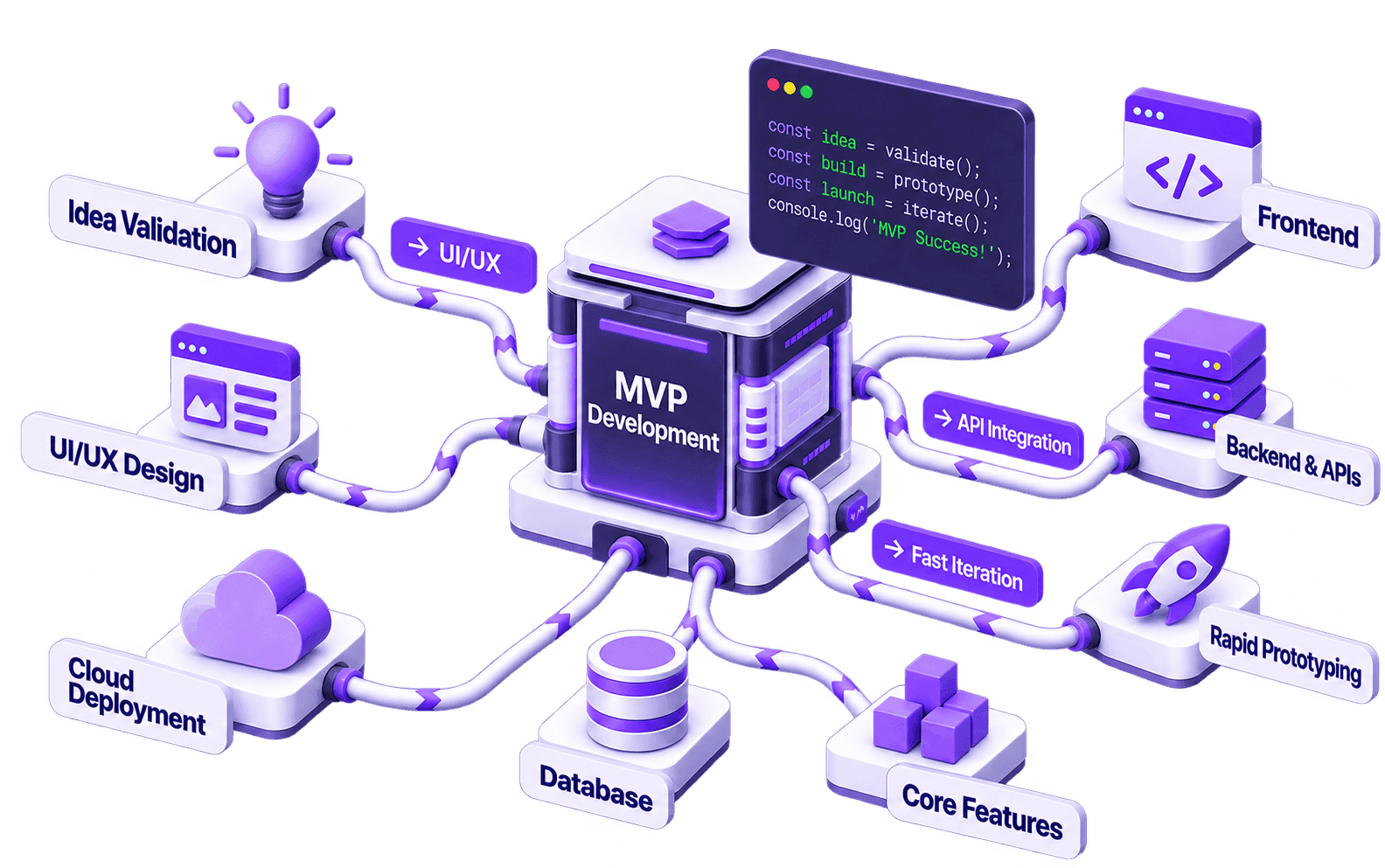
MVP Development architecture visualization
In scope
MVP Development
- 01 coveredReact & Next.js MVP Development
- 02 coveredNode.js & Full-Stack MVP Development
- 03 coveredMobile App MVP Development
- 04 coveredSaaS MVP Development
- 05 coveredPrototype & Proof of Concept Development
5 areas covered
What MVP Development Includes
My MVP development services cover everything from idea validation to a working, launch-ready product. The process includes scoping, design, development, testing, and deployment, built around what your startup actually needs to prove first.
MVP development services cover more than a rough version of an app pushed out the door. My MVP software engineering approach includes architecture, data flow, and the features a startup actually needs to test its idea. I treat MVP application development as a discipline, with MVP application development services and custom MVP development services built to support both web and mobile launches. Every MVP software development project starts with the same question. What does this product need to prove in the next few months? That question shapes my MVP software development services and keeps scalable MVP development at the center of every decision.
An MVP is not a smaller version of your product with fewer features bolted off. It is a full working system, just scoped down to the smallest set of parts that can still prove your idea. Here is how those parts actually work together once the MVP is live, not just the steps used to build it.
React handles what the user sees, but it never talks to the database directly. Every action goes through a Node.js API first, which checks the request and only then reads from or writes to the database. This is what keeps an early MVP architecture from turning into a mess later. You can redesign a screen without touching how data is stored, and you can change the database without breaking a feature your first users already depend on.
What makes this mvp development service different?
- custom MVP development
- rapid MVP development
- end-to-end MVP development
Leverage End-to-End MVP Development Services
Here's the full range of MVP development work I handle, from first prototype through to a scalable, launch-ready product.
- 01
React & Next.js MVP Development
React and Next.js are my default for MVP web development because they let me move fast without sacrificing structure. Server-side rendering, rapid page loads, clean component architecture, all things that matter once real users show up. Next.js also makes SEO easier out of the box, which matters if your MVP needs organic traffic to prove demand, not just paid ads.
- 02
Node.js & Full-Stack MVP Development
I build scalable Node.js back-end APIs, and business logic that scale past MVP without a rewrite. Full-stack MVP development means the front end and back end are designed to work together from the start, not cobbled together under the pressure of a deadline. This matters more than people expect.
- 03
Mobile App MVP Development
For mobile, I build with React Native, which lets me ship to iOS and Android from a single codebase. That cuts your MVP development timeline roughly in half compared to building two native apps separately. It's not the right call for every product, but for most early-stage mobile MVPs, it gets you to launch faster without much of a tradeoff.
- 04
SaaS MVP Development
SaaS MVP development comes with its list of must-haves: user accounts, billing, and basic role permissions. I build these in from the start, even in a lean version, because retrofitting billing logic later is a real headache. The goal with a SaaS MVP isn't every feature your roadmap eventually needs. It's the smallest version that proves people will actually pay for what you're building.
- 05
Prototype & Proof of Concept Development
There are times when you’re not ready for a full MVP—you just need something to test an idea or show investors. I build prototypes and proof-of-concept versions fast, focused purely on proving the concept works. This step can save months. If a proof of concept reveals the idea doesn't hold up, you've lost a couple of weeks, not a couple of quarters.
- 06
MVP Validation & Testing
An MVP that ships without real user testing is basically a guess with extra steps. I build in feedback loops early, so you're validating assumptions with actual users, not just your team's opinions. MVP validation isn't a one-time event either. I’ve set it up so you can keep testing and tuning after the initial launch.
- 07
MVP to Product Development & Scaling
Your MVP validates the concept, and then you scale up to a complete product instead of starting from zero. I plan the architecture early with the transition in mind, so MVP to product development is a natural next phase, not a rebuild. This is where many MVPs quietly fail.
- 08
eCommerce & Marketplace MVP Development
For eCommerce and marketplace ideas, the MVP usually needs to prove one thing: that both sides of the transaction actually show up. I build lean checkout flows, listings, and payment handling that work without every bell and whistle attached.
- 09
Dashboard & Portal MVP Development
Internal tools and B2B products often start as an MVP dashboard or portal. I focus these builds on the core workflow your users need, then expand based on what they actually use once it's live.
Common MVP Development Challenges I Solve
Most founders come to me stuck on one of a handful of problems. Here's what shows up most often.
Too Many Features, Not Enough Focus
Feature creep kills more MVPs than bad code ever does. I help founders cut scope down to what actually needs testing so the build stays fast and the product stays focused.
MVPs Built Without a Scalable Foundation
Plenty of MVPs get built so fast they can't handle any real growth. I build lean, but I do so carefully, ensuring that scaling later does not require a complete rewrite or mean starting from scratch.
Slow Time to Market
Every additional week before launch is a week during which competitors could narrow the gap. I keep builds lean and focused specifically to protect your timeline, not just your budget.
No Clear Path From MVP to Full Product
Many MVPs get built in a corner that makes them impossible to extend. I architected from day one with the next version already in mind.
Limited Budget, Big Product Vision
Most early-stage founders can't build everything they eventually want. I help figure out what actually needs to exist now versus what can wait until after you've raised or earned more.
Uncertainty Around Product-Market Fit
If you're not sure people want your product yet, building a massive product is the wrong move. I build the smallest version that can honestly answer that question.
How I Approach MVP Development
Every MVP I build follows a consistent process, adjusted for your specific idea and timeline. Here's how it usually goes.
Discovery & Idea Validation
We begin by testing the idea: who it's for, what problem it solves, and how to quickly verify that problem's existence.
Feature Prioritization & Scope Planning
This is where we cut the feature list down to what version one actually needs and park everything else for later.
UI/UX & Prototype Design
I design the core user flows and interface before writing production code, so we're not guessing what the experience should feel like.
Core MVP Development
The MVP is the actual build: frontend, backend, database, and the core functionality your MVP needs to work end-to-end.
Testing & Quality Assurance
Before launch I test the functionality, performance, and usability so you don’t hear about the issues from your first users.
Launch & User Feedback
When it’s live, I help create ways to actually capture and act on user feedback, not just track vanity metrics.
Cloud Deployment
I’ll get you running on a cloud platform that fits your budget and scale, and that’s ready for real users from day one.
Post-Launch Iteration & Support
After launch, I stick around to help you interpret feedback and build the next iteration based on what users actually did, not what the roadmap assumed.
Technologies Used for MVP Development
The stack gets chosen around your specific product and timeline, not applied the same way to every project regardless of fit.
Frontend
- React
- Next.js
- TypeScript
Mobile
- React Native
Backend & APIs
- Node.js
- Express.js
- REST APIs
Databases
- PostgreSQL
- MongoDB
- Redis
Cloud & DevOps
- AWS
- Docker
- CI/CD
How I Build MVP Products
I build MVPs fast, but not carelessly. Clean, modular code that can be extended once the product proves itself, rather than rewritten from scratch after a successful launch. Every MVP ships with basic documentation too. If you bring on more developers later, they shouldn't need to guess how the early decisions were made.
An MVP is not a smaller version of your product with fewer features bolted off. It is a full working system, just scoped down to the smallest set of parts that can still prove your idea. Here is how those parts actually work together once the MVP is live, not just the steps used to build it.
React handles what the user sees, but it never talks to the database directly. Every action goes through a Node.js API first, which checks the request and only then reads from or writes to the database. This is what keeps an early MVP architecture from turning into a mess later. You can redesign a screen without touching how data is stored, and you can change the database without breaking a feature your first users already depend on.
Underneath that sits the part most founders never think about until it breaks: hosting, deployment, and basic monitoring. I deploy MVPs to cloud infrastructure that fits your budget today but does not box you in later. This scalable MVP architecture is what lets a lean first version handle its first thousand users, then keep working without a rebuild once that number grows into something much larger.
This is also why MVP development strategy matters as much as the code itself. A build planned with the next stage in mind lets you add features later without touching the parts that are already working.
Where this shows up
- SaaS Products
- eCommerce Platforms
- Marketplaces
- Mobile Apps
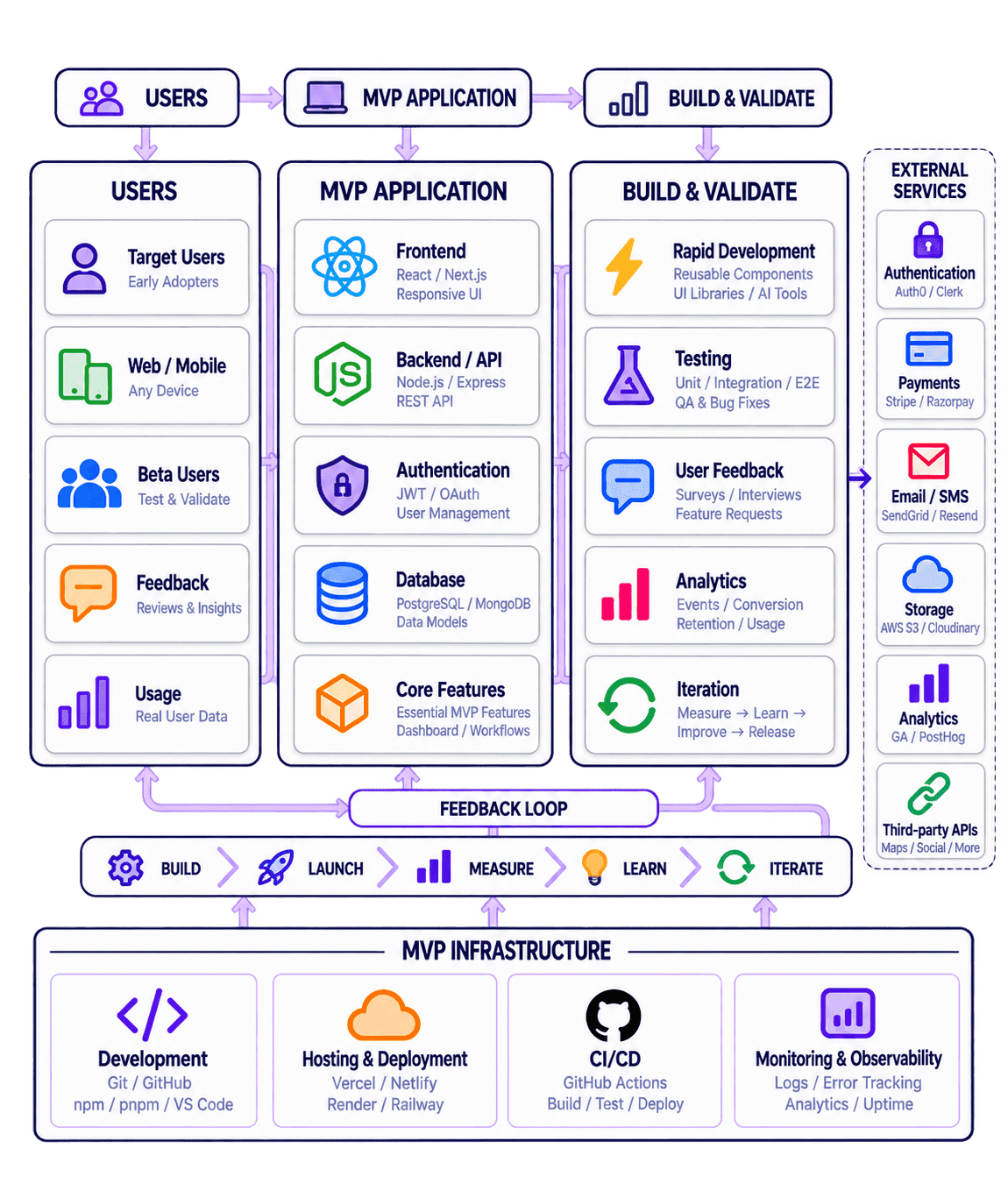
MVP Development system architecture architecture visualization
MVP Development Use Cases
MVP development applies across a wide range of product types. Here's where I've built the most.
SaaS Products
SaaS MVPs need to prove people will pay, not just use the product for free. I build the smallest version that can answer that honestly.
eCommerce Platforms
eCommerce MVPs test whether people will actually complete a purchase, which means checkout and payment need to work well even in a lean build.
Marketplaces
Marketplace MVPs require both the supply and demand sides to function simultaneously, even in a limited capacity, or else the concept of Marketplace MVPs must simultaneously engage both the supply and demand sides, even in a limited capacity, to effectively test the concept.
Mobile Apps
Mobile MVPs often go with React Native to hit both iOS and Android without doubling the build time and cost.
Internal Tools & Dashboards
Not every MVP is customer-facing. Internal tool MVPs need to prove a workflow works before a company commits to building it out fully.
Proof-of-Concept Products
Some MVPs are created solely to address a specific question before any real budget is committed. I build proof-of-concept versions that focus on quickly testing a single assumption.
Who My MVP Development Services Are For
MVP development services work for a range of founders and teams, from a first idea on a napkin to an established company testing something new.
First-Time Founders With an Idea
If this project is your first product, I help translate the idea into something buildable and scoped realistically for a first version.
Startups Ready to Validate Product-Market Fit
If you've got a clear idea but no proof yet, I build the version that gets you real answers fastest.
Businesses Building a New Digital Product
Established companies testing a new product line still need a lean MVP first, not a fully loaded build on day one.
Companies Looking to Hire Without a Full-Time Team
If hiring a full team doesn't make sense yet, I work as your dedicated MVP developer for the scope you actually need.
What's Included in My MVP Development Services
Every MVP project comes with a full set of deliverables, not just a working app. Here's what's included.
Complete MVP Build
A functional, launch-ready MVP covering the core features your product needs to test with real users.
UI/UX Design & Prototyping
We build out prototypes, and design the interface before starting development, so the product experience is deliberate, and not an improvisation.
Core Feature Development
Your MVP builds your MVP's core features cleanly enough to allow for future extensions without the need for a complete rebuild. Cleanly enough so that it can be extended in the future without having to be rebuilt.
Scalable MVP Architecture
An architecture that can grow into a full product once the MVP proves the concept works.
Cloud Deployment and Monitoring
Deploy to a cloud platform in your budget, and implement rudimentary monitoring to catch issues early.
Testing & Quality Assurance
Functional, and usability testing before launch, so your first users aren't the ones finding the bugs.
Third-Party Integration
Payment processors, analytics programs, authentication providers, whatever your MVP needs to work right Start with building your MVP with a list of payment processors, analytics programs, authentication providers, and any other required components to make it work. cleanly from the start.
Post-Launch Support
Once your MVP is live and collecting real data, help interpret user feedback, resolve issues and plan the next iteration.
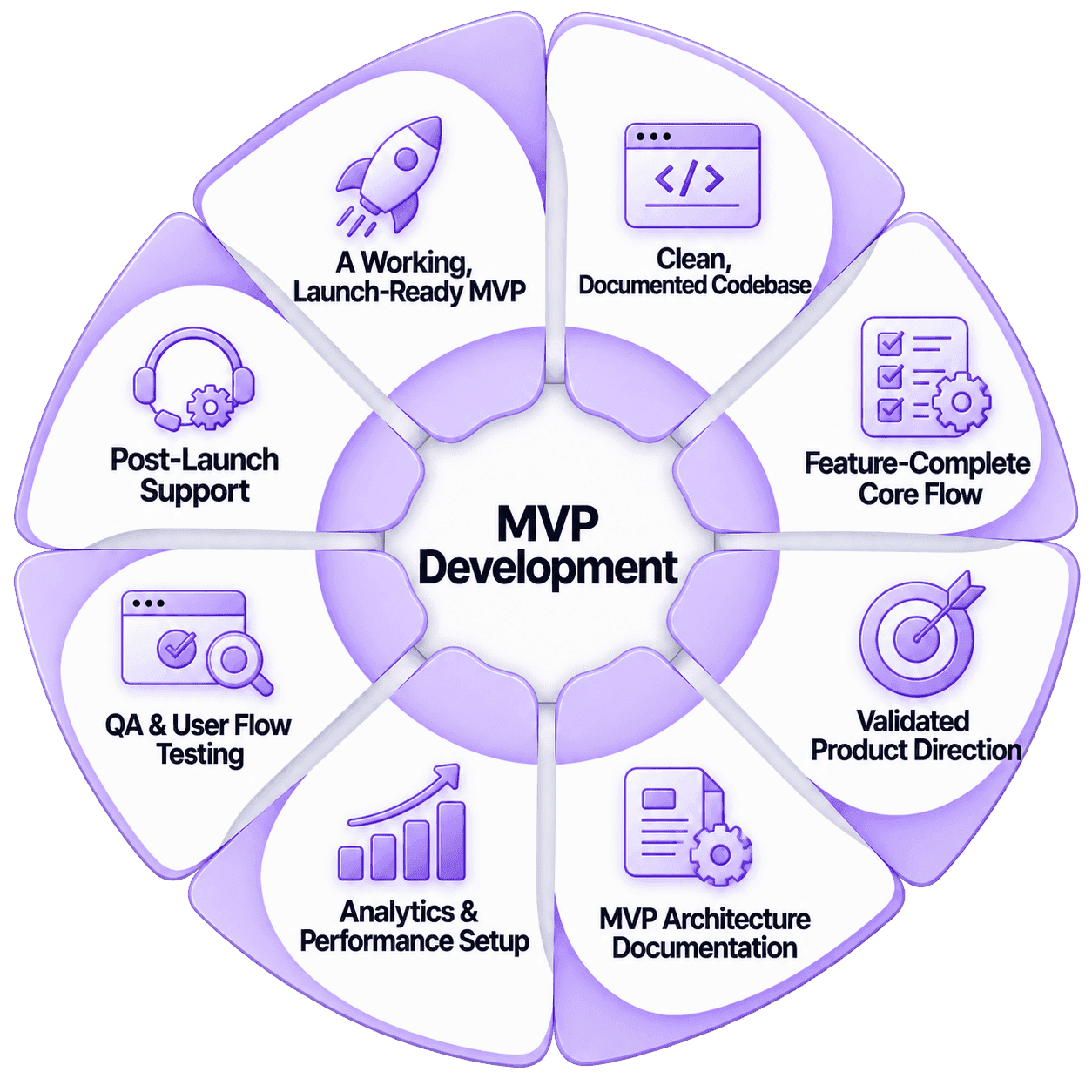
Benefits of MVP Development
A properly scoped MVP changes the entire trajectory of a startup, not just the first few months.
- Benefit
Faster Time to Market
A lean, focused build gets you in front of users weeks or months earlier than a fully loaded first version.
- Benefit
Lower Development Costs
You build just enough to test the idea, and you can spend way less money before deciding if it is worth scaling.
- Benefit
Validated Product Direction
Real user feedback tells you what to build next, instead of guessing based on internal opinions.
- Outcome
Investor-Ready Product
An MVP in action with real users is a much stronger pitch than a deck full of mockups, and assumptions.
- Outcome
Reduced Risk
Testing the core idea early gives you immediate feedback that something needs to change before it becomes too costly to do so.
- Outcome
Easier Path to Scale
An MVP built with the next stage in mind means scaling later doesn't require throwing out the existing product.
Why Hire Me as a MVP Developer?
You're working directly with the person building your product, not a rotating team learning your idea from scratch each sprint.
Speed Fast MVP Development & Launch
I move quickly because speed is often the whole point of an MVP, without cutting corners that create problems later.
Precision Focused MVP Feature Development
Every feature gets built with attention to what it's actually supposed to prove, not just what looks appealing in a demo.
Full Full MVP Development Ownership
I own the build from scoping through launch, so there's no confusion about who's responsible for what.
Clear Clear & Direct Communication
You receive plain language updates throughout so you always know where the project really is.
Flexibility Flexible MVP Development & Iteration
Scope shifts as you learn more from users, and I adjust the build with you instead of resisting change.
Long-Term Long-Term MVP Product Support
I’ll still be there after launch to help with the next iteration, not just the first version.
MVP Development Projects & Examples
The projects I've worked on that are related to mvp development.
View Spendly - Expense Tracker TanStack StartReactTypeScriptSupabasePremium Personal Expense Tracker
Spendly - Expense Tracker
A personal expense tracker that turns everyday spending into a clear picture. Log an expense in seconds, set a monthly budget, and import your spending history from CSV or Excel. Totals and category breakdowns show up on one calm, private dashboard. Built with TanStack Start, React, and Supabase, with row-level security so every number stays private.
- Live dashboard with totals, six-month trends, and category charts
- CSV and Excel import with column mapping, plus one-click filtered export
View project
View Real-Time Chat Application Next.jsNode.jsTypeScriptWebSocketsReal-Time Group Chat
Real-Time Chat Application
A lightweight real-time group chat app built with WebSockets. It handles instant messaging, chat rooms, typing indicators, and seen status. The whole thing runs as a Turborepo monorepo, with a Next.js frontend and a Node.js backend. The result is a chat experience that feels fast, clean, and genuinely responsive.
- Instant rooms, typing indicators, and seen receipts, all over WebSockets
- Turborepo setup with a Next.js client and a dedicated Node.js socket server
View project
MVP Development Services FAQs
Practical answers about MVP scope, cost, and how the process works. These cover the questions founders ask most before starting an MVP development services engagement.
Still evaluating fit?
Tell me about your product context - I'll return with honest feedback on scope and timeline.