SaaS Development
SaaS Development Services
I provide SaaS development services to startups, SaaS teams and businesses that need reliable architecture, secure APIs and databases built for real growth. I specialize in SaaS application development and SaaS product engineering. This service covers everything from the first architecture decision to the day your platform handles thousands of paying users. My work includes multi-tenant architecture, billing systems, API design, and cloud setup. You work with one developer who knows your whole product.
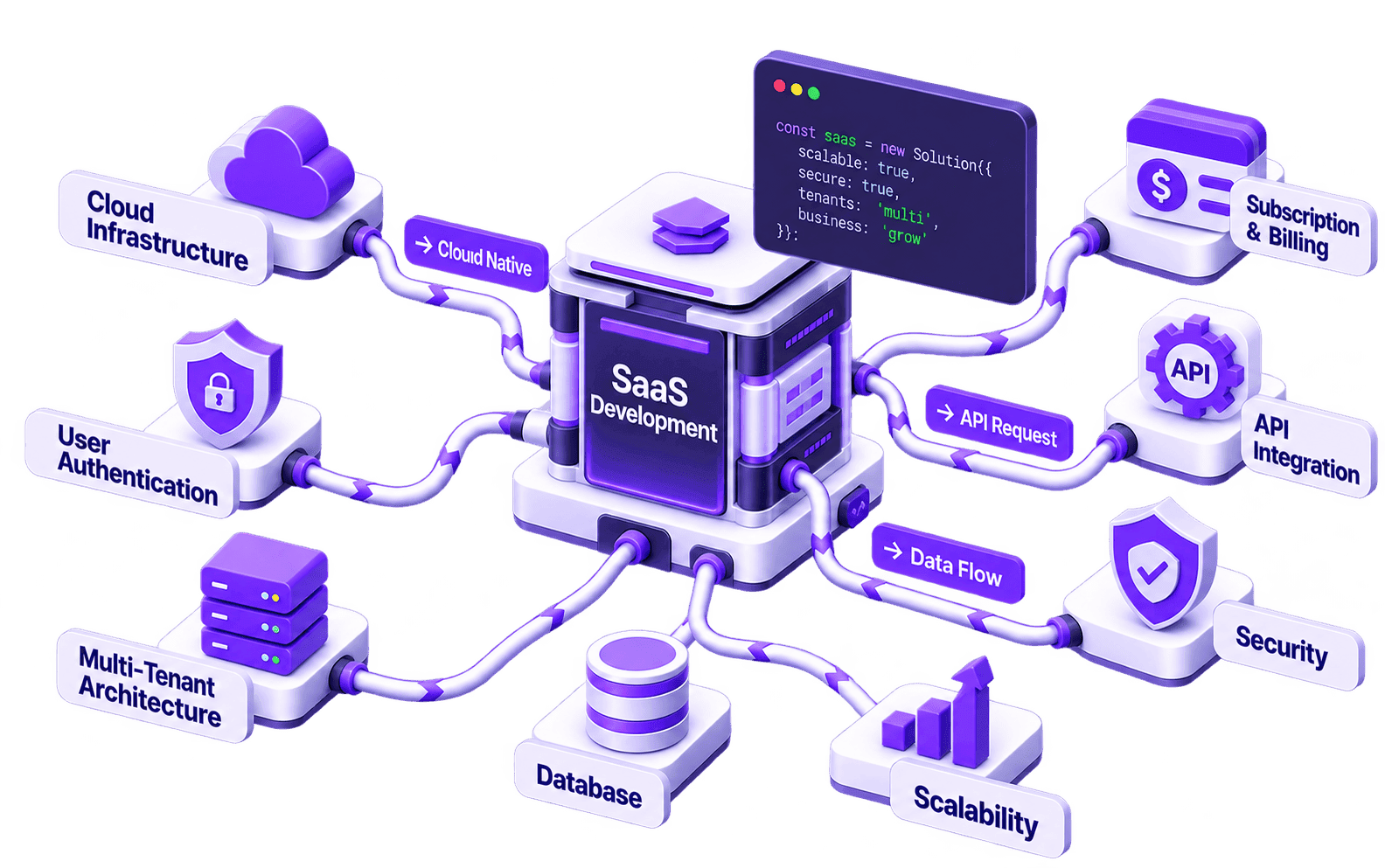
SaaS Development architecture visualization
In scope
SaaS Development
- 01 coveredMERN & Next.js SaaS Development
- 02 coveredSaaS API Development & Integration
- 03 coveredSaaS Database Development & Design
- 04 coveredMulti-Tenant SaaS Architecture
- 05 coveredSaaS Billing & Subscription Management
5 areas covered
What SaaS Development Includes
SaaS development services cover more than a working login screen and a dashboard. My SaaS development services include tenant management, billing, API work, and security, built as one connected system. The goal stays simple. The product should stay easy to extend as plans, features, and users grow. I treat SaaS product engineering as its own discipline, not a rushed add-on to a general web build. SaaS engineering services here always plan for scaling beyond the first release.
Every project starts with one question. What does this engagement for SaaS application development services need to support in a year? That question shapes my custom SaaS application development and custom SaaS software development choices. It applies to internal tools, customer portals, and full SaaS web application development builds for growing companies. SaaS development solutions here mean the codebase stays simple to change. My SaaS product development process always includes clear documentation and a data model another developer can follow.
Modular, testable code that doesn't need reverse-engineering months later is the standard I hold every SaaS build to. Business logic stays separated from billing logic, and billing logic stays separated from tenant management, so nothing turns into one tangled file that only I can explain. Every SaaS platform ships with proper documentation, covering how the architecture fits together and why key decisions were made along the way. A system nobody understands eventually becomes a system nobody can safely update, and that's a risk I build against from day one.
Multi-tenant logic gets handled with extra care, since a small mistake here can expose one customer's data to another. I explicitly mark tenant boundaries all over the codebase, instead of having one shared check somewhere in the middle of the application. Database queries, API routes, and background jobs all respect those boundaries consistently, so scaling to more tenants doesn't mean revisiting old logic and hoping nothing was missed. This kind of discipline matters more in SaaS development than in almost any other type of product
What makes this saas development service different?
- End-to-end SaaS development, from first schema to production
- Scalable SaaS development built in from day one
- Enterprise SaaS development architecture for teams that plan to grow
Leverage End-to-End Custom SaaS Development Services
Here's the full range of SaaS development work I take on. Broken down by what each part involves.
- 01
MERN & Next.js SaaS Development
I build most SaaS apps on the MERN stack. Backend developed with Node.js and Frontend with React or Next.js. This combo handles the real-time updates and dashboards most SaaS products need. It also holds up as you grow. A SaaS platform built this way doesn't need a rewrite just because your user base jumped from a few hundred to a few thousand.
- 02
SaaS API Development & Integration
API development sits at the center of almost every SaaS product I build. It's the layer that connects your web app, mobile app, and any third-party tools to the data underneath. I build REST APIs when predictability matters most. I use GraphQL when your frontend needs flexible, specific data. Every endpoint gets documented clearly. Your team never has to guess what a response looks like.
- 03
SaaS Database Development & Design
A rushed database schema is the top reason SaaS platforms slow down as they grow. Duplicate records, missing indexes, tables that were never built for multiple tenants. It all traces back to a schema made for a quick demo, not a growing product. I design schemas around how your SaaS product actually queries and separates tenant data. Not just how it stores that data.
- 04
Multi-Tenant SaaS Architecture
Multi-tenant SaaS architecture is one of the hardest parts of building a SaaS platform. It is also the stage where most initial errors tend to occur. I build tenant isolation, role-based access, and authentication into the architecture itself. Not bolted on after customers start signing up. Some products need strict separation of data between tenants. Other people can share resources better. I pick the multi-tenancy model based on your real security and scaling needs. Not a generic default setup.
- 05
SaaS Billing & Subscription Management
Subscription logic sounds simple. Then you add upgrades, downgrades, failed payments, and prorated billing across hundreds of accounts. I build SaaS billing systems with Stripe and similar gateways. They're built to handle these edge cases without quietly losing revenue. Recurring billing, invoicing, and pricing tiers all get built around how your product actually makes money.
- 06
SaaS Cloud, DevOps & Deployment
I deploy most SaaS platforms to AWS. The exact setup depends on what your product already runs on. Docker keeps environments consistent across development, staging, and production. CI/CD pipelines mean a new feature ships without anyone touching a server at midnight. Cloud SaaS development is really about infrastructure that reacts on its own. Traffic spikes get handled automatically. You're not paying for capacity that sits idle overnight.
- 07
SaaS Security & Performance
Security often gets treated like a final checklist item. I build it in from the start instead. Authentication, authorization, and tenant data isolation are part of the architecture. Not something added after a scare. Performance works the same way. I test query speed and API response times all through development. I don't wait for a customer to complain that the dashboard is slow.
- 08
SaaS Dashboard & Portal Development
Admin dashboards, customer portals, and analytics views. Users interact with these more than anything else, even though people rarely talk about them first. I build these to load fast and stay clear, even as the data keeps growing. Different user roles usually need different views of the same data. I structure permissions so adding a new role later doesn't mean rebuilding the whole dashboard.
- 09
SaaS Third-Party & System Integrations
CRMs, payment gateways, marketing tools, whatever your business already runs on. I connect these to your SaaS platform, so data moves on its own instead of getting copied by hand. Third-party APIs change without much warning, more often than most teams expect. I build integrations that fail loudly and alert someone right away. Not integrations that quietly drop data for weeks.
Common SaaS Development Challenges I Solve
Most founders don't call a SaaS developer before something breaks. They call right after. These are the most common issues I encounter.
Slow, Unpredictable Performance Under Real Traffic
A SaaS platform that feels instant in a demo can crawl once real users show up. I dig into query performance, caching, and server setup to find the real bottleneck. Not just patch the symptom.
A Database That Was Never Built for Multi-Tenancy
This happens more than people think. A schema gets thrown together to launch fast. The product gets customers. Two years later, that schema can't cleanly separate tenant data anymore. I redesign these without taking your live platform offline.
SaaS Architecture With No Clear Structure
Features get added over time with no real plan. Eventually nobody on the team understands how the whole system fits together. I map the entire platform first. Then I refactor it into something documented and easy to follow.
Fragile Third-Party Integrations
The worst kind of bug fails quietly. An integration breaks, nobody notices for a week, and now there's a pile of unsynced customer data. I rebuild these with real logging and real alerts.
No In-House SaaS Development Expertise
Plenty of founders don't need a full-time engineering team yet. They need a dedicated SaaS developer for one specific build. I step in for exactly the scope you need. Nothing extra.
Security Gaps Discovered Too Late
Most SaaS security gaps aren't caused by carelessness. They happen because nobody had time to check properly. I go through authentication flows, tenant data handling, and API access before a small gap turns into a real problem.
How I Approach SaaS Development
I follow the same process on every SaaS project. It keeps timelines honest and ensures no big things fall through the cracks.
Discovery & Requirements
Before I write any code, I need to understand your product, your users, and how your SaaS platform makes money. This step can feel slow. Skipping it usually causes bigger problems later.
API Architecture & Planning
I map out endpoints, data flow, and how your frontend and backend will talk to each other. Nobody guesses mid-build what a response should look like.
Database Design & Modeling
Schema design and tenant separation happen here. Along with figuring out which queries your SaaS platform will run the most as it scales.
Core SaaS Development
This is most of the work. Business logic, subscription handling, user roles, and the actual features your SaaS product needs day to day.
Integration & Third-Party APIs
Whatever external tools your platform depends on, payment processors, CRMs, or analytics, get connected and tested here.
Security & Testing
I check for bugs, security holes and how the system handles real load across multiple tenants before anything ships. Not just a single happy-path demo.
Cloud Deployment & CI/CD Pipeline
Your SaaS platform gets deployed to your preferred cloud provider. CI/CD gets set up so future updates roll out safely, on their own.
Launch & Ongoing Support
Once launched, I’m still involved. Monitoring, bug fixes, and updates continue as your product changes. A SaaS platform is never really finished.
SaaS Analytics Platforms
SaaS analytics platform development brings its load, since dashboards often pull from large, constantly changing datasets. I build these to stay fast and accurate, even as reporting needs grow.
Technologies Used for SaaS Development
I don't reuse the same stack for every client, though. The right tools depend on your data, your traffic, and what your team can maintain after I'm gone.
Frontend
- React
- Next.js
- TypeScript
Backend & APIs
- Node.js
- Express.js
- NestJS
- REST APIs
- GraphQL
Databases & Caching
- PostgreSQL
- MongoDB
- Redis
Cloud & DevOps
- AWS
- Docker
- CI/CD
Authentication & Integrations
- OAuth
- JWT
- Third-Party APIs
- Webhooks
How I Build SaaS Systems
I follow the same process on every SaaS project. It keeps timelines honest and ensures no big things fall through the cracks.
Modular, testable code that doesn't need reverse-engineering months later is the standard I hold every SaaS build to. Business logic stays separated from billing logic, and billing logic stays separated from tenant management, so nothing turns into one tangled file that only I can explain. Every SaaS platform ships with proper documentation, covering how the architecture fits together and why key decisions were made along the way. A system nobody understands eventually becomes a system nobody can safely update, and that's a risk I build against from day one.
Multi-tenant logic gets handled with extra care, since a small mistake here can expose one customer's data to another. I explicitly mark tenant boundaries all over the codebase, instead of having one shared check somewhere in the middle of the application. Database queries, API routes, and background jobs all respect those boundaries consistently, so scaling to more tenants doesn't mean revisiting old logic and hoping nothing was missed. This kind of discipline matters more in SaaS development than in almost any other type of product
This isn't just a nice extra either. It protects your business long term, especially as your team grows or changes. If I'm ever unavailable for a future update, another developer can open the codebase, read through the documentation, and make sense of the architecture fast, without needing a lengthy handover call first. That kind of clarity also makes it easier to bring on additional developers later, since the system doesn’t depend on knowledge that exists only in one person’s head.
Where this shows up
- B2B SaaS Platforms
- SaaS Marketplace Platforms
- SaaS Dashboards & Customer Portals
- Fintech & Healthcare SaaS
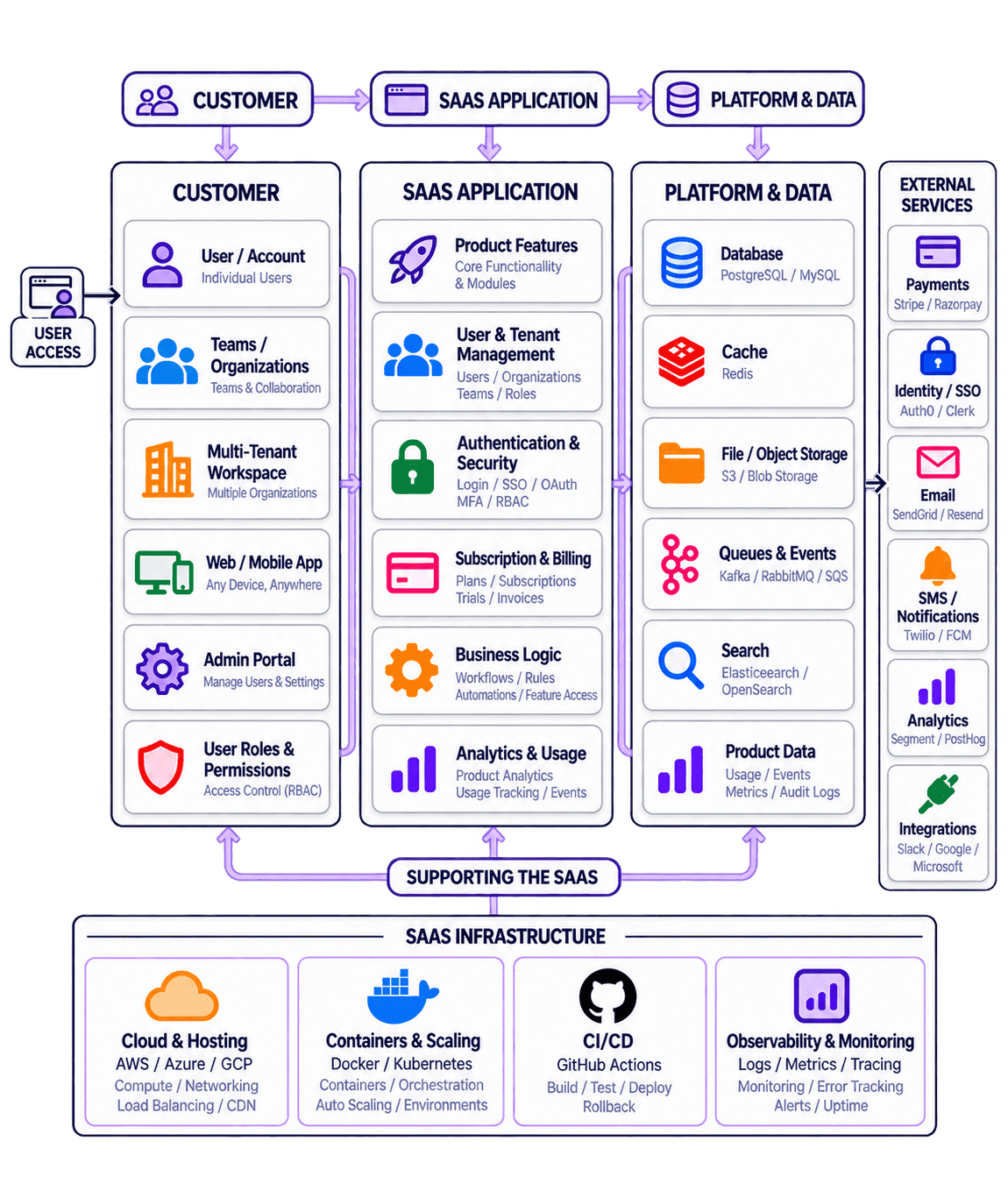
SaaS Development system architecture architecture visualization
SaaS Development Use Cases
SaaS development shows up across many kinds of products. Here's where I've spent the most time building.
B2B SaaS Platforms
Multi-tenant architecture, role-based permissions, and billing logic all need to work from day one. B2B customers rarely tolerate downtime or mixed-up data.
SaaS Marketplace Platforms
Multiple user types, commission logic, and payment processing all need to hold up during busy periods. Not just on a quiet weekday.
SaaS Dashboards & Customer Portals
These live or die on speed. I work on the backend, making sure that data comes in fast as the dataset grows.
Fintech & Healthcare SaaS
Extra care goes into encryption, access control, and compliance here. These industries leave very little room for fixing things later.
Internal SaaS Tools
Internal SaaS tools get overlooked a lot. But they still need a platform that won't fail under daily use. I keep these simple, without over-building them.
SaaS Analytics Platforms
SaaS analytics platform development brings its load, since dashboards often pull from large, constantly changing datasets. I build these to stay fast and accurate, even as reporting needs grow.
Who My SaaS Development Services Are For
Startups, growing companies, and established businesses all end up here for different reasons. Here's how that usually breaks down.
Startups Building Their First SaaS Product
If this is your first SaaS build, I help you ship something solid. Without over-engineering a version one that doesn't need to support a million users yet.
Growing Businesses Outgrowing No-Code SaaS Tools
At some point, no-code tools stop keeping up with real demand. I move you onto a custom SaaS platform built for the traffic you're dealing with now.
Enterprises Needing Reliable SaaS Systems
Larger organizations need SaaS platforms that are tested well, secured properly, and built to meet strict uptime rules across many accounts.
Companies Looking to Hire Without a Full-Time Role
If a full-time SaaS team isn't realistic yet, I offer dedicated SaaS development scoped to exactly what your project needs.
What's Included in My SaaS Development Services
Every project includes more than code dropped into a repo. Here's what actually gets delivered.
Complete SaaS Platform
The full system. Business logic, multi-tenant architecture, and every core feature your SaaS product needs to run.
API Development & Integration
Custom REST, or GraphQL APIs and other integrations with any third-party services your platform requires.
Database Design & Optimization
Not a generic template. A schema built around your real tenant structure and how your app queries data.
Scalable SaaS Architecture
Architecture that can grow with your users and data without having to be re-built from the ground up.
Cloud Deployment & Monitoring
Deploy to your favorite cloud platform, with monitoring set up to alert on issues before a customer ever notices.
Security & Quality Assurance
Authentication, tenant data handling and every API endpoint get checked thoroughly before anything goes live.
Third-Party Integration
Payment gateways, CRMs, and any other tools your business already uses get connected. Your platform doesn't work in isolation.
Post-Launch Support
Bug fixes, updates, and help keep your SaaS platform current as your product and users keep growing.
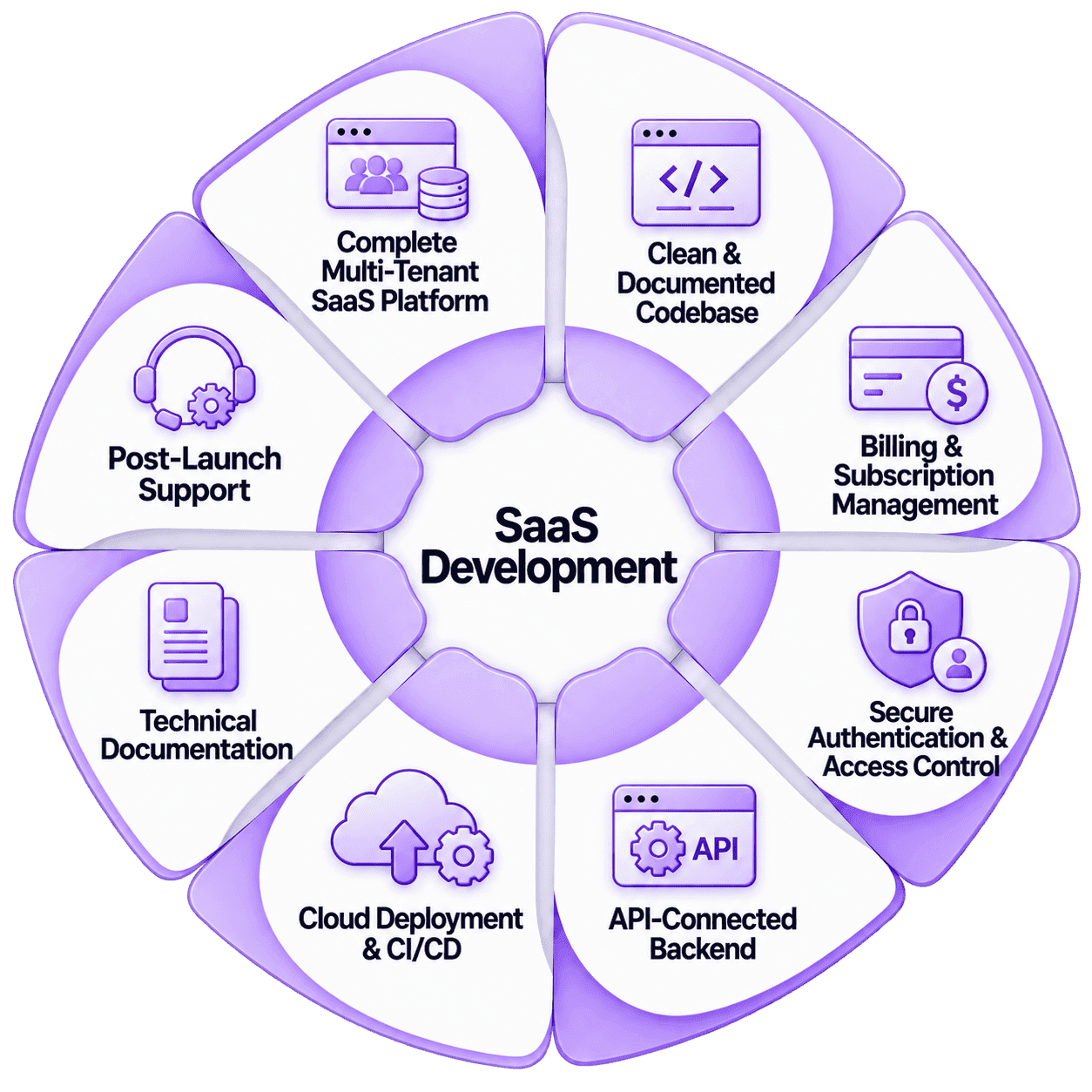
Benefits of Custom SaaS Development
A SaaS platform built right changes how the whole business runs. Not just how the product looks on a demo call.
- Benefit
Faster SaaS Applications
Optimized queries and clean backend code mean users stick around instead of bouncing while a page loads.
- Benefit
Fewer Outages
A good SaaS platform will be able to handle traffic spikes and errors without the whole product crashing.
- Benefit
Lower Long-Term Costs
Clean, documented code is much less expensive to maintain. Cutting corners early just means expensive repairs later.
- Outcome
Systems That Scale With You
The right architecture means growth doesn't force a rebuild every time you hit a new milestone.
- Outcome
More Precise Tenant Data
Tenant data is consistent through sound database design. That makes reporting and new features much easier to build.
- Outcome
Safer By Default
Security built in from the start means fewer surprises. And a lot less cleanup if something does go wrong.
Why Hire Me as a SaaS Developer?
You're hiring the person who actually writes the code. Not a project manager relaying updates from someone else. Here's what that gets you.
Speed Fast & Scalable SaaS Development
I move fast without skipping the parts that matter. Your timeline stays realistic instead of dragging on for months.
Precision Precise SaaS Architecture & Development
Details get real attention. From how an API responds to how tenant data gets separated at the schema level.
Full End-to-End Ownership
I own what I build. There's no blaming "the last developer," because there isn't one on this project.
Clear Clear & Direct Communication
Updates come in plain language. You won't need a glossary to understand what's happening with your build.
Flexibility Flexible SaaS Development
I work around your existing tools and team. Not the other way around.
Long-Term Long-Term SaaS Product Support
I don't disappear after launch. If something needs fixing six months later, I'm still around and I still remember the system.
SaaS Development Projects & Examples
The projects I've worked on that are related to saas development.
View PMS - HR Management System ReactNode.jsPostgreSQLREST APIHR Management System
PMS - HR Management System
I built a full HR platform for a mid-sized company. It covers attendance, leave requests, payroll, and role-based access. It also connects to their existing ERP system, so nothing had to be rebuilt from scratch.
- Attendance, leave, payroll, and role-based access handled in one HR cycle
- Integrated into an existing ERP system without a rewrite
View project
View Spendly - Expense Tracker TanStack StartReactTypeScriptSupabasePremium Personal Expense Tracker
Spendly - Expense Tracker
A personal expense tracker that turns everyday spending into a clear picture. Log an expense in seconds, set a monthly budget, and import your spending history from CSV or Excel. Totals and category breakdowns show up on one calm, private dashboard. Built with TanStack Start, React, and Supabase, with row-level security so every number stays private.
- Live dashboard with totals, six-month trends, and category charts
- CSV and Excel import with column mapping, plus one-click filtered export
View project
View Philantro AI - NGO Management Platform ReactNode.jsExpress.jsMongoDBAI-Powered NGO Management Platform
Philantro AI - NGO Management Platform
I built a full NGO management platform. It has a form builder, report generation, a chart builder, and milestone tracking, all fully configurable. I also worked on the UI itself, using AI tools like Visily to turn early ideas into Figma designs, then into real React components that render on the server.
- Configurable form builder, reports, charts, and milestone tracking in one platform
- AI-assisted prototyping, from Visily to Figma to production React
View project
View Verify 360 - KYC & Identity Verification Platform React NativeReactNode.jsExpress.jsDigital Identity Verification & KYC Platform
Verify 360 - KYC & Identity Verification Platform
I built a KYC platform for identity checks. It verifies documents and checks 3D liveness. It also tracks live location and connects to outside identity APIs. A built-in scoring system flags risky users. It now handles more than 100 client verifications.
- Document verification, 3D liveness detection, and live geolocation tracking
- Risk scoring built to flag suspicious users during KYC checks
View project
SaaS Development Services FAQs
Here are the questions I get asked most about SaaS development services and how I usually answer them.
Still evaluating fit?
Tell me about your product context - I'll return with honest feedback on scope and timeline.