Frontend Development
Frontend Development Services
I provide frontend development services to product companies, SaaS teams, and startups. I have expertise in the development of Next.js and React. Are you in search of frontend development for a new product? Or would you like to expand your team by employing front-end developers? Both of these are included in my frontend development services.
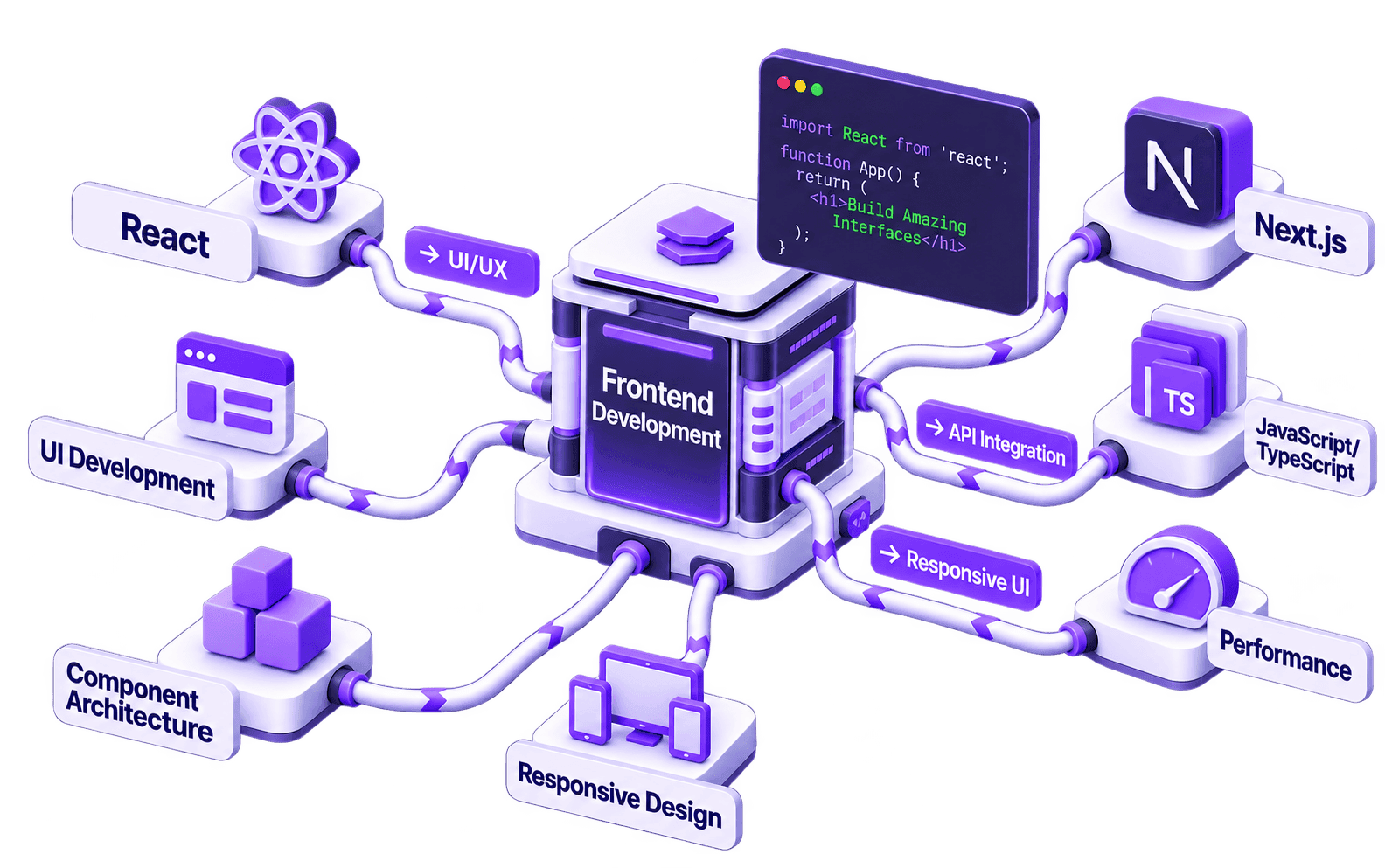
Frontend Development architecture visualization
In scope
Frontend Development
- 01 coveredReact & Next.js Development
- 02 coveredJavaScript & TypeScript Development
- 03 coveredUI Development
- 04 coveredComponent Architecture
- 05 coveredStyling & Design Systems
5 areas covered
What Frontend Development Includes
My frontend development services cover the full interface. UI design, components, responsiveness, performance, and support after launch. Nothing here is templated. Every frontend gets built around how your product actually works.
Most frontend development services pass your project between different developers as people become free. I don't work that way. The person who plans your UI is the same person who builds it.
Every component I build stays modular and testable, so nothing needs reverse-engineering six months down the line. A button handles clicks. A form handles input. Nothing tries to juggle five responsibilities at once, which keeps bugs easy to trace back to their source. Every frontend I ship comes with documentation, because a system nobody understands eventually becomes a system nobody can safely touch. That documentation isn't an afterthought bolted on at the end. It gets written alongside the code, while the reasoning behind each decision is still fresh.
State management gets the same careful treatment. I keep data flow predictable instead of scattering it across random files, and components, so when something eventually breaks, I can trace exactly where it started instead of guessing across the entire application. This is most important as a product grows, when a messy state setup will turn minor bugs into hours of debugging. I structure things so data moves in one clear direction, which keeps the whole codebase easier to reason about, even for someone seeing it for the first time.
What makes this frontend development service different?
- End-to-end frontend development, from component to production
- Responsive web development built in from day one
- Modern React and Next.js frontend architecture
Leverage End-to-End Modern Frontend Development Services
Here's the full range of frontend development work I take on. Broken down by what each part involves.
- 01
React & Next.js Development
I build most interfaces with React and Next.js when a product needs server-side rendering, or better SEO. This combo handles complex, interactive UIs without turning into a mess of tangled code. It also holds up as you grow. A frontend built this way doesn't need a rewrite just because your product added ten new features overnight.
- 02
JavaScript & TypeScript Development
JavaScript powers the logic behind every interaction on your site. TypeScript adds structure on top of that, catching bugs before they ever reach a real user. I default to TypeScript for anything beyond a small project. It makes the codebase easier to maintain and easier for another developer to understand later without guessing.
- 03
UI Development
Good UI development isn't just about how something looks. It's about how easily a user can actually get things done on the page. Every screen gets designed around real user behavior, not just a design trend. Buttons, forms, and navigation all need to feel obvious the first time someone uses them.
- 04
Component Architecture
I build reusable UI components from the start, so a button or a form doesn't get rebuilt five different ways across your product. One component, used everywhere it's needed. This keeps your codebase small and predictable. Fixing a bug in one component fixes it everywhere that component gets used, instead of hunting through five copies of the same code.
- 05
Styling & Design Systems
I use Tailwind CSS for most projects, since it keeps styling consistent and fast to update. Custom CSS still gets used where a design needs something Tailwind doesn't handle well. A proper design system means colors, spacing and typography stay consistent across every page. Nobody has to guess which shade of blue is the "right" one anymore.
- 06
PWA Development
Progressive web apps let your product work more like a native app, right from the browser. Offline support, push notifications, and home screen installs all come with a well-built PWA. I build these for products that need app-like reliability without the cost, and delay of publishing to app stores.
- 07
SPA Development
Single-page applications load once, then update content instantly as users navigate, without a full page reload each time. This makes the experience feel fast and smooth. I build SPAs with React, handling routing, and state so the app stays fast as time goes on, and more screens and features are added.
- 08
Micro Frontend Development
Micro frontend development breaks a large application into smaller, independent pieces that different teams can build, and ship on their own schedule. This matters most for bigger products with multiple teams working on the same platform. Each piece is isolated so that a change by one team doesn’t accidentally break another team’s screen.
- 09
Performance & Cross-Device Support
A slow frontend loses users before they even see what you're offering. I optimize load times, image management and code splitting so pages load instantly, not slowly. Cross-device and cross-browser testing happens throughout the build, not at the end. A layout that breaks on one phone or browser is still broken, no matter how good it looks elsewhere.
Common Frontend Development Challenges I Solve
Most founders don't call a frontend developer before something breaks. They call right after. These are the problems I see most of the time.
Slow-Loading Pages Under Real Traffic
A page that loads fast on a fast connection can crawl on a slower one. I dig into bundle size, image loading, and rendering to find the real bottleneck. Not just patch the symptom.
Inconsistent UI Across Devices and Browsers
This happens more than people think. A layout looks fine on one screen size and breaks on another. I rebuild these with proper responsive rules, tested across real devices, not just a browser preview.
Frontend Code With No Clear Structure
Features get added over time with no real plan. Eventually nobody on the team understands how the components fit together. I map the whole interface first. Then I refactor it into something documented and easy to follow.
Broken API Integrations
The worst kind of bug fails quietly. Data doesn't load, and the screen just sits there blank with no error shown. I rebuild these with proper loading states and clear error handling.
No In-House Frontend Expertise
Plenty of founders don't need a full-time frontend team yet. They need a dedicated frontend developer for one specific build. I step in for exactly the scope you need. Nothing extra.
Accessibility and Performance Gaps Found Too Late
Most accessibility and performance issues aren't caused by carelessness. They happen because nobody had time to check properly. I test for both throughout the build, not after launch.
How I Approach Frontend Development
I follow the same process on every frontend project. It keeps timelines honest and makes sure nothing important gets missed.
Discovery & Requirements
Before I write any code, I need to understand your product, your users and how they'll actually use the interface. This step can feel slow. Skipping it usually causes bigger problems later.
UI/UX Architecture & Planning
I map out screens, user flows and how components will connect to each other. Nobody guesses mid-build what a page should look like.
Component Design & Modeling
Reusable components get planned here. Along with figuring out which pieces of the UI will get reused the most across the product.
Core Frontend Development
This is most of the work. Building out screens, wiring up components and making the interface actually function the way it's meant to.
API Integration
Whatever backend or third-party data your frontend depends on gets connected, and tested here, with proper loading and error states.
Testing & Performance
Before anything ships, I test across devices, browsers, and real network conditions. Not just a single happy-path demo on a fast connection.
Deployment & CI/CD Pipeline
Your frontend gets deployed to your preferred hosting platform. CI/CD gets set up so future updates roll out safely, on their own.
Launch & Ongoing Support
I stay involved after launch. Monitoring, bug fixes and updates continue as your product changes. A frontend is never really finished.
Technologies Used for Frontend Development
React, Next.js, JavaScript, TypeScript, Tailwind CSS and HTML5 make up my core frontend development stack. I don't reuse the same stack for every client, though. The right tools depend on your product, your users, and what your team can maintain after I'm gone.
Frameworks & Libraries
- React
- Next.js
- Vue.js
Languages
- TypeScript
- JavaScript
- HTML5
- CSS3
UI & Styling
- Tailwind CSS
- Shadcn UI
- Material UI
- Bootstrap
- Custom CSS
Development Approach
- Component-Based Development
- Reusable UI Components
- Responsive Design
How I Build Frontend Systems
A frontend that only looks good in a demo isn't built to last. I focus on how the system holds up months after launch, not just how it performs during the first walkthrough, and that approach shapes every decision I make.
Every component I build stays modular and testable, so nothing needs reverse-engineering six months down the line. A button handles clicks. A form handles input. Nothing tries to juggle five responsibilities at once, which keeps bugs easy to trace back to their source. Every frontend I ship comes with documentation, because a system nobody understands eventually becomes a system nobody can safely touch. That documentation isn't an afterthought bolted on at the end. It gets written alongside the code, while the reasoning behind each decision is still fresh.
State management gets the same careful treatment. I keep data flow predictable instead of scattering it across random files, and components, so when something eventually breaks, I can trace exactly where it started instead of guessing across the entire application. This is most important as a product grows, when a messy state setup will turn minor bugs into hours of debugging. I structure things so data moves in one clear direction, which keeps the whole codebase easier to reason about, even for someone seeing it for the first time.
Naming conventions, and folder structure follow a clear, consistent pattern from day one, not something figured out halfway through the build. A new developer joining the project later can find what they need quickly, without digging through unrelated files first. This isn't just a nice extra either. It protects you long-term. If I'm ever unavailable for a future update, another developer can read the code, understand the structure and make sense of it fast, without needing me to explain it first.
Where this shows up
- SaaS Products
- eCommerce Platforms
- Dashboards & Portals
- Marketing & Business Websites
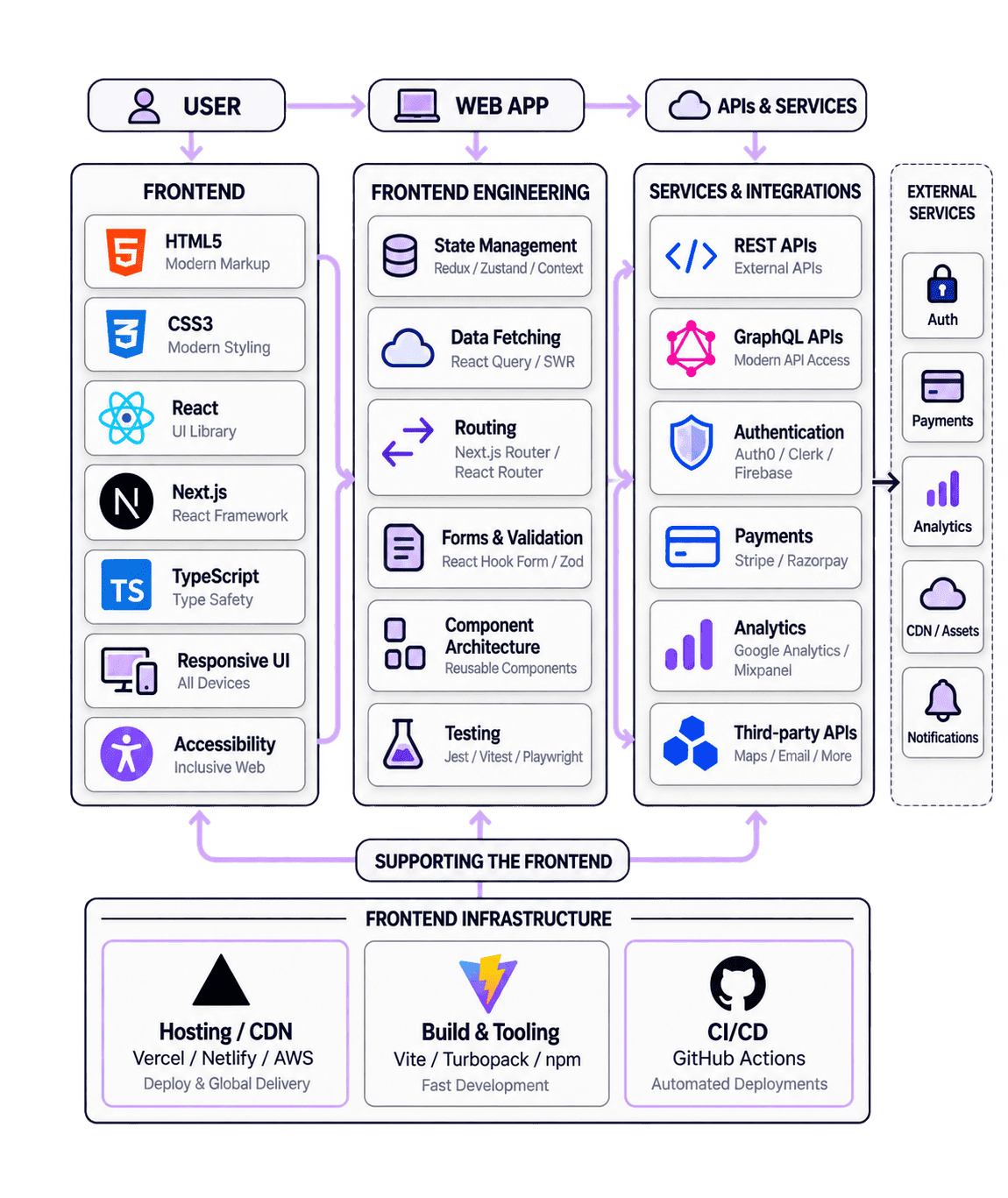
Frontend Development system architecture architecture visualization
Frontend Development Use Cases
Frontend development shows up across many kinds of products. Here's where I've spent the most time building.
SaaS Products
SaaS UI development needs to stay clean and fast, even with dense data and multiple user roles running through the same screens.
eCommerce Platforms
Product pages, checkout flows, and search all need to load fast and feel simple. A slow checkout page costs real sales.
Dashboards & Portals
These live or die on clarity. I build a dashboard UI that stays readable even as the amount of data keeps growing.
Marketing & Business Websites
First impressions matter here. A fast, clean interface builds trust before a visitor reads a single word of content.
Internal Tools
Internal tools get overlooked a lot. But they still need an interface that's simple to use every single day. I keep these lean, without over-building them.
Enterprise Web Applications
Enterprise frontend applications need to handle more users, more roles, and more data than a typical product. I build these to stay stable and fast under that extra weight.
Who My Frontend Development Services Are For
Startups, growing companies, and established businesses all end up here for different reasons. Here's how that usually breaks down.
Startups Building Their First Interface
If this is your first product interface, I help you ship something solid. Without over-engineering a version one that doesn't need every feature yet.
Growing Businesses Outgrowing Template Websites
At some point, a template site stops keeping up with real demand. I move you onto a custom frontend built for the traffic and features you actually need now.
Enterprises Needing Reliable Interfaces
Larger organizations need frontends that are tested well, accessible, and built to meet strict performance expectations across many users.
Companies Looking to Hire Without a Full-Time Role
If a full-time frontend team isn't realistic yet, I offer dedicated frontend development scoped to exactly what your project needs.
Agencies Needing a Frontend Specialist
Some agencies need an extra frontend developer for a single client project, without adding someone to their permanent team. I plug in as that specialist for as long as the project needs.
SaaS Companies Needing Dedicated Frontend Support
SaaS teams often need one developer focused just on the interface, while the rest of the team handles backend and product work. I step in for SaaS frontend development without adding a full-time seat to your team.
What's Included in My Frontend Development Services
Every project includes more than code dropped into a repo. Here's what actually gets delivered.
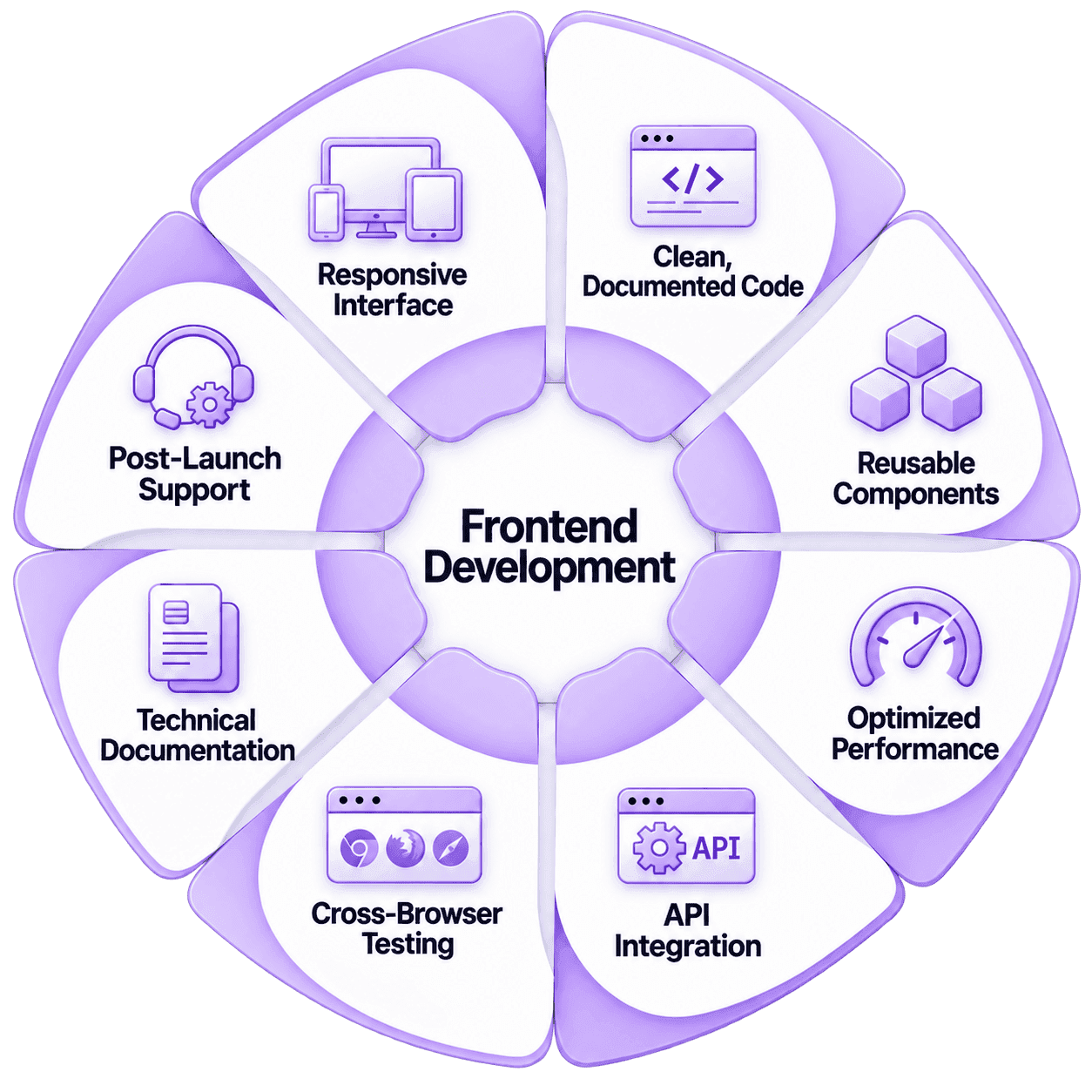
Complete Frontend Application
The full interface. Screens, components, and every core feature your product needs to actually work.
UI Development & Component Architecture
Reusable, well-structured components built once, and used consistently across your entire product.
Responsive Design
A layout that works cleanly across phones, tablets and desktops, not just the screen size used during testing.
Frontend Performance Optimization
Fast load times, and smooth interactions, checked throughout the build, not bolted on at the end.
Integration API
Proper loading and error handling with clean reliable connections to your backend or third party services.
Quality Assurance and Testing
Every screen is tested on devices and browsers before it goes live.
Cross Browser Compatibility
Same experience no matter what they are on, consistent behavior between major browsers.
Post-Launch Support
Bug fixes, updates, and help keep your frontend current as your product and users keep growing.
Benefits of Modern Frontend Development
A frontend built right changes how users experience the entire product. Not just how it looks on a demo call.
- Benefit
Faster Websites
Optimized code, and smart loading mean users stay engaged instead of bouncing while a page loads.
- Benefit
Fewer Bugs
A well-structured frontend catches issues early, instead of surfacing them after real users find them first.
- Benefit
Lower Long-Term Costs
Clean, documented code is far easier to maintain. Shortcuts taken early tend to be expensive fixes later.
- Outcome
Systems That Scale With You
With the right component architecture, you don’t have to rebuild everything when you add a new feature.
- Outcome
Cleaner Code
Consistent structure keeps the codebase readable, which makes new features much easier to build later.
- Outcome
Better User Experience
A fast, clear interface keeps users on the page longer, and more likely to come back.
Why Hire Me as a Frontend Developer?
You're hiring the person who actually writes the code. Not a project manager relaying updates from someone else. Here's what that gets you.
Speed Fast & Responsive Frontend Development
I move fast without skipping the parts that matter. Your timeline stays realistic instead of dragging on for months.
Precision Precise UI & Frontend Implementation
Details get real attention. From how a button responds to how a layout holds up on a smaller screen.
Full End-to-End Frontend Ownership
I own what I build. There's no blaming "the last developer," because there isn't one on this project.
Clear Clear & Direct Communication
Updates come in plain language. You won't need a glossary to understand what's happening with your build.
Flexibility Flexible Frontend Development
I work around your existing tools and team. Not the other way around.
Long-Term Long-Term Frontend Support
I don't disappear after launch. If something needs fixing six months later, I'm still around and I still remember the system.
Experience
Years building production interfaces
Projects
Frontend builds delivered across SaaS, eCommerce, and internal tools
Scope
Comfortable owning frontend, API integration, and design systems together
Frontend Development Projects & Examples
A few real projects show how these choices play out, not just in theory.
View Spendly - Expense Tracker TanStack StartReactTypeScriptSupabasePremium Personal Expense Tracker
Spendly - Expense Tracker
A personal expense tracker that turns everyday spending into a clear picture. Log an expense in seconds, set a monthly budget, and import your spending history from CSV or Excel. Totals and category breakdowns show up on one calm, private dashboard. Built with TanStack Start, React, and Supabase, with row-level security so every number stays private.
- Live dashboard with totals, six-month trends, and category charts
- CSV and Excel import with column mapping, plus one-click filtered export
View project
View MiniList - Headless CMS Next.jsNestJSTypeScriptPostgreSQLHeadless Content Management System
MiniList - Headless CMS
A full-stack headless CMS with a modern Next.js admin dashboard and a scalable NestJS backend. It handles rich text editing, blog and author management, API keys, analytics, Google OAuth, and SEO tools. A REST API sits underneath for smooth content delivery. Built on Prisma and PostgreSQL, so it stays clean, scalable, and easy to self-host.
- Next.js admin panel and NestJS API, built as a self-hostable headless CMS
- Rich text, authors, SEO fields, API keys, and Google OAuth in one place
View project
View Real-Time Chat Application Next.jsNode.jsTypeScriptWebSocketsReal-Time Group Chat
Real-Time Chat Application
A lightweight real-time group chat app built with WebSockets. It handles instant messaging, chat rooms, typing indicators, and seen status. The whole thing runs as a Turborepo monorepo, with a Next.js frontend and a Node.js backend. The result is a chat experience that feels fast, clean, and genuinely responsive.
- Instant rooms, typing indicators, and seen receipts, all over WebSockets
- Turborepo setup with a Next.js client and a dedicated Node.js socket server
View project
View Philantro AI - NGO Management Platform ReactNode.jsExpress.jsMongoDBAI-Powered NGO Management Platform
Philantro AI - NGO Management Platform
I built a full NGO management platform. It has a form builder, report generation, a chart builder, and milestone tracking, all fully configurable. I also worked on the UI itself, using AI tools like Visily to turn early ideas into Figma designs, then into real React components that render on the server.
- Configurable form builder, reports, charts, and milestone tracking in one platform
- AI-assisted prototyping, from Visily to Figma to production React
View project
Frontend Development Services FAQs
Here are the questions I get asked most about frontend development services and how I usually answer them.
Still evaluating fit?
Tell me about your product context - I'll return with honest feedback on scope and timeline.