Full Stack Development
Full Stack Development Services
I provide full-stack development services for businesses, start-ups and individuals who want one developer to take care of frontend, backend, database, and deployment without having to interface with separate teams. I build scalable, production-ready web applications from scratch, who understand the whole product from architecture to launch.
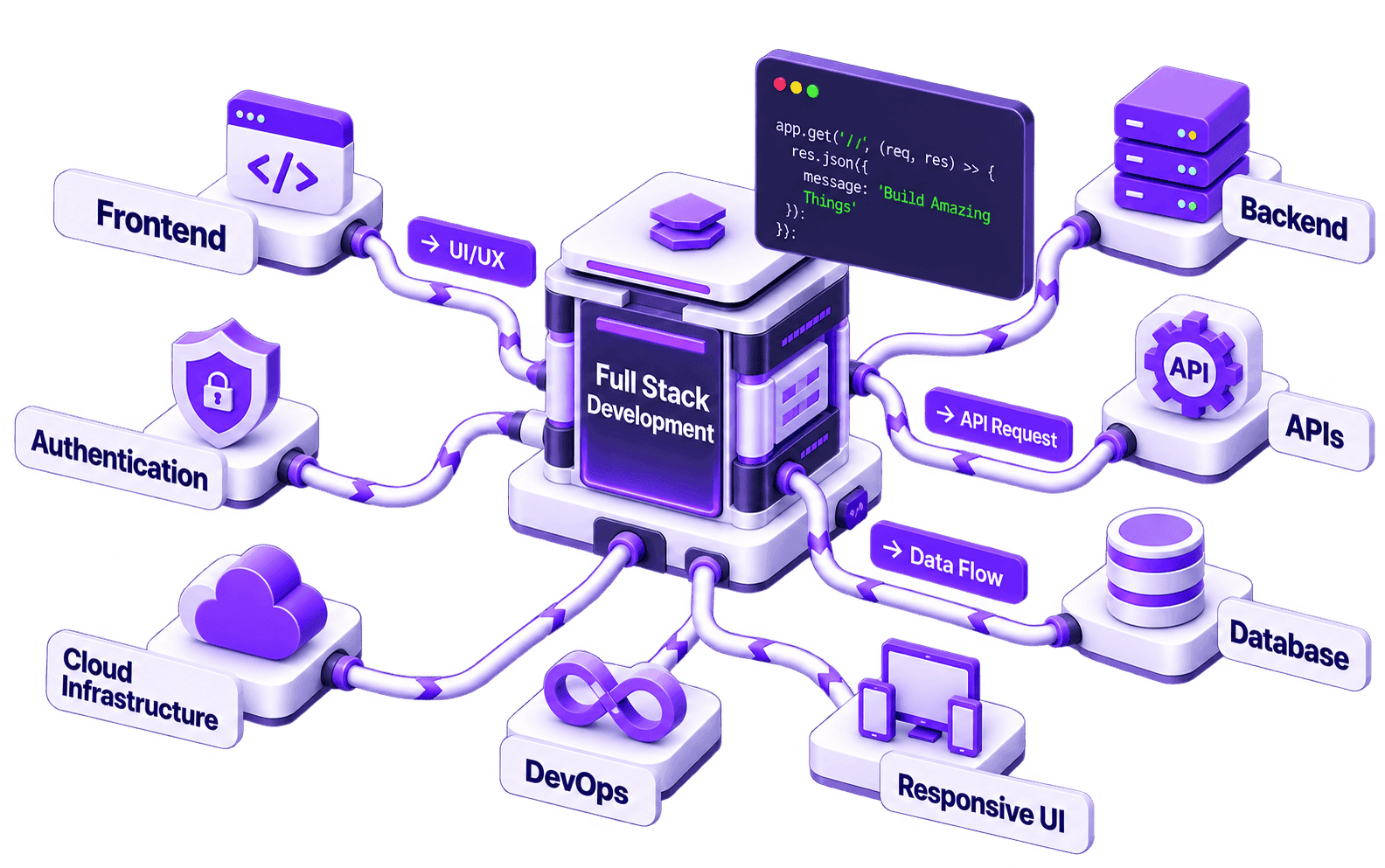
Full Stack Development architecture visualization
In scope
Full Stack Development
- 01 coveredFrontend Development
- 02 coveredBackend Development
- 03 coveredAPI Development & Integration
- 04 coveredDatabase Design & Development
- 05 coveredCloud & DevOps Setup
5 areas covered
What Full Stack Development Includes
Full stack software development means one person handles the whole app. Not just one layer of it.
Most software projects fail at the handoff. A designer builds something the frontend can't ship. The frontend team builds a UI the backend can't support. The backend team builds an API the database was never built for. My full stack web development services remove that gap. One person owns how every piece fits. From the first sketch to the live app.
The frontend never touches the database on its own. Every request from the browser hits the API first. The API checks who's asking. It decides what they can see. Only then does it read or write to the database. This split keeps the app stable. You can redesign the screen without touching how data gets stored. You can rework the database without breaking what a user sees.
Under all that sits the setup that keeps things running. AWS runs the servers. Docker keeps every part acting the same in every setting. CI/CD pushes updates out on its own. No one has to remember the right steps by hand. None of these three parts make choices about your product. They just keep the app live, self-fixing, and ready for more users.
What makes this full stack development service different?
- End-to-end full stack development
- Scalable web application development
- Modern frontend and backend integration
Leverage End-to-End Full Stack Web Development Services
Full stack web development services cover every layer of a modern app. From the screen your users tap, to the server logic and database behind it. Nothing gets left for another team to sort out later.
- 01
Frontend Development
I build fast, clean, and responsive web apps with React.js and Next.js. I use JavaScript when I need more freedom, and TypeScript when a project needs stronger type checks. Every screen is responsive design. It works great on desktop, tablet, phone.
- 02
Backend Development
I build server-side apps using Node.js and Express.js. My backend development services focus on clean code, safe APIs, and a setup that grows with you. New backend or an old one needing a fix, I build it to last.
- 03
API Development & Integration
I build and connect APIs so systems can talk to each other. This covers REST API development, GraphQL development, and API integration with payment tools, CRMs and other third-party platforms. My goal is simple. Keep every connection safe, steady, and easy to maintain.
- 04
Database Design & Development
A solid database is the base of any good app. I've worked with PostgreSQL, MongoDB and MySQL. Database development is my strong point. Structure, links between data, queries, and speed all get planned. So your app stores and pulls data fast, even as it grows.
- 05
Cloud & DevOps Setup
I move apps from a laptop to a live server the right way. I’m working with AWS, Docker and CI/CD for testing and rollouts. The goal stays simple. Deploy it, watch it, update it, grow it. No manual headaches.
- 06
SaaS & Product Development
I build SaaS apps, and MVPs to turn ideas into real products. I focus on the core features first. Get it in front of real users. Then improve it with real feedback. New SaaS launch or an update to an old one, I can build the tech behind it.
- 07
eCommerce & Marketplace Development
I build real online stores and multi-vendor platforms. My eCommerce application development and marketplace development work covers listings, checkout, payments, stock, accounts, and vendor tools. The focus stays on a smooth buying experience. One that holds up under real traffic and a growing product list.
- 08
AI & Automation Development
I build real AI features and automation that save teams time. This covers AI apps, LLM tools, chatbots, and task automation. I link AI to your APIs, databases, CRMs, and other tools. So the boring work runs on its own. The goal is simple. Build AI that's useful, steady, and easy to keep.
- 09
Enterprise Application Development
I build software for big organizations that require rigorous security and well defined user roles. This spans frontend, backend, APIs, databases, and internal tools. Role-based access, audit trails, and integrations get planned early. So the app can grow with the company.
Common Full Stack Development Challenges I Solve
Most full stack problems come from broken links between systems, old code, or no clear owner. Here are the ones I see most. And how the right fix solves each one early.
Disconnected Frontend and Backend Systems
When the interface and server get built by different teams at different times, small changes turn into big projects. I rebuild the link between the two. So your app works as one system, not two glued together.
Applications That Slow Down as They Grow
Many apps run fine with ten users. Then they break at ten thousand. I plan for scalable web application development from day one. So speed doesn't become a rebuild job later.
Legacy Stacks Nobody Wants to Touch
Old code is costly to run and risky to change. I check what's still worth keeping. Then I rebuild the rest with tech that's still well-supported.
Fragmented APIs and Broken Integrations
A half-working third-party API integration is one of the most common fixes I get called for. I rebuild these links. So data flows the right way between your systems.
No In-House Full Stack Expertise
Not every company needs a full-time hire. Hire a full stack developer for one project, or bring in dedicated full stack developers for a set scope. Either way, you get senior-level work with no long-term cost.
SaaS or MVP Products That Can't Keep Up
Early SaaS builds often skip real planning to move fast. I step in and fix the base. So MVP application development doesn't turn into a full rebuild six months later.
How I Approach Full Stack Development
I follow eight steps on every project. From discovery and planning, through backend work and database design, to cloud setup and support after launch. You always know what's happening, and why.
Discovery & Requirements
Every project starts with the real problem. Not just a feature list. That problem shapes every choice made in custom software development.
Architecture & Planning
I map the full stack setup before writing any code. Choices about the database, API layout, and hosting get made on purpose. Not by accident.
UI/UX & Frontend Development
Screens get built with current frontend and UI standards. Tested across devices as I build them.
Backend & API Development
Server logic and backend work happen next to frontend work. APIs get exposed early. So both sides can be tested together.
Database Design & Integration
Schemas get built around your real data. Database design and hookup happen before real data gets loaded in.
Cloud Setup & Deployment
Cloud setup starts in week one. Not right before launch.
Testing & Quality Assurance
Every feature gets tested against real use, before it reaches your users. This catches issues while they're still cheap to fix.
Launch & Ongoing Support
After launch, I stay close. Watching, fixing, and supporting DevOps. So the app keeps running the way it should.
Technologies Used for Full Stack Development
I build with a modern, well-known stack. Not tools only I understand. Here's what I use most, along with common combos like MERN stack development and React Node.js development.
Frontend
- React
- Next.js
- TypeScript
- JavaScript
Backend & APIs
- Node.js
- Express.js
- NestJS
- REST APIs
- GraphQL
Databases & Caching
- PostgreSQL
- MongoDB
- MySQL
- Redis
Cloud & DevOps
- AWS
- Docker
- CI/CD
How I Build Full Stack Applications
A full stack app is not three systems that just happen to talk. It's a system. Every layer depends on how the others are built. Here's how the pieces work once it's live. Not just the steps used to build it.
The frontend never touches the database on its own. Every request from the browser hits the API first. The API checks who's asking. It decides what they can see. Only then does it read or write to the database. This split keeps the app stable. You can redesign the screen without touching how data gets stored. You can rework the database without breaking what a user sees.
Under all that sits the setup that keeps things running. AWS runs the servers. Docker keeps every part acting the same in every setting. CI/CD pushes updates out on its own. No one has to remember the right steps by hand. None of these three parts make choices about your product. They just keep the app live, self-fixing, and ready for more users.
There's also a check running under every screen tap. Logs and alerts run across the frontend, backend, and database at once. If the API slows down, or the database sees an odd spike, it shows up on a screen fast. Before a user ever notices.
This structure matters most once real traffic hits. A slow query or a bad deploy stays contained to one layer, instead of taking the whole app down. That's what makes full stack development services reliable long after launch, not just on day one.
Where this shows up
- SaaS
- eCommerce
- Healthcare
- Fintech
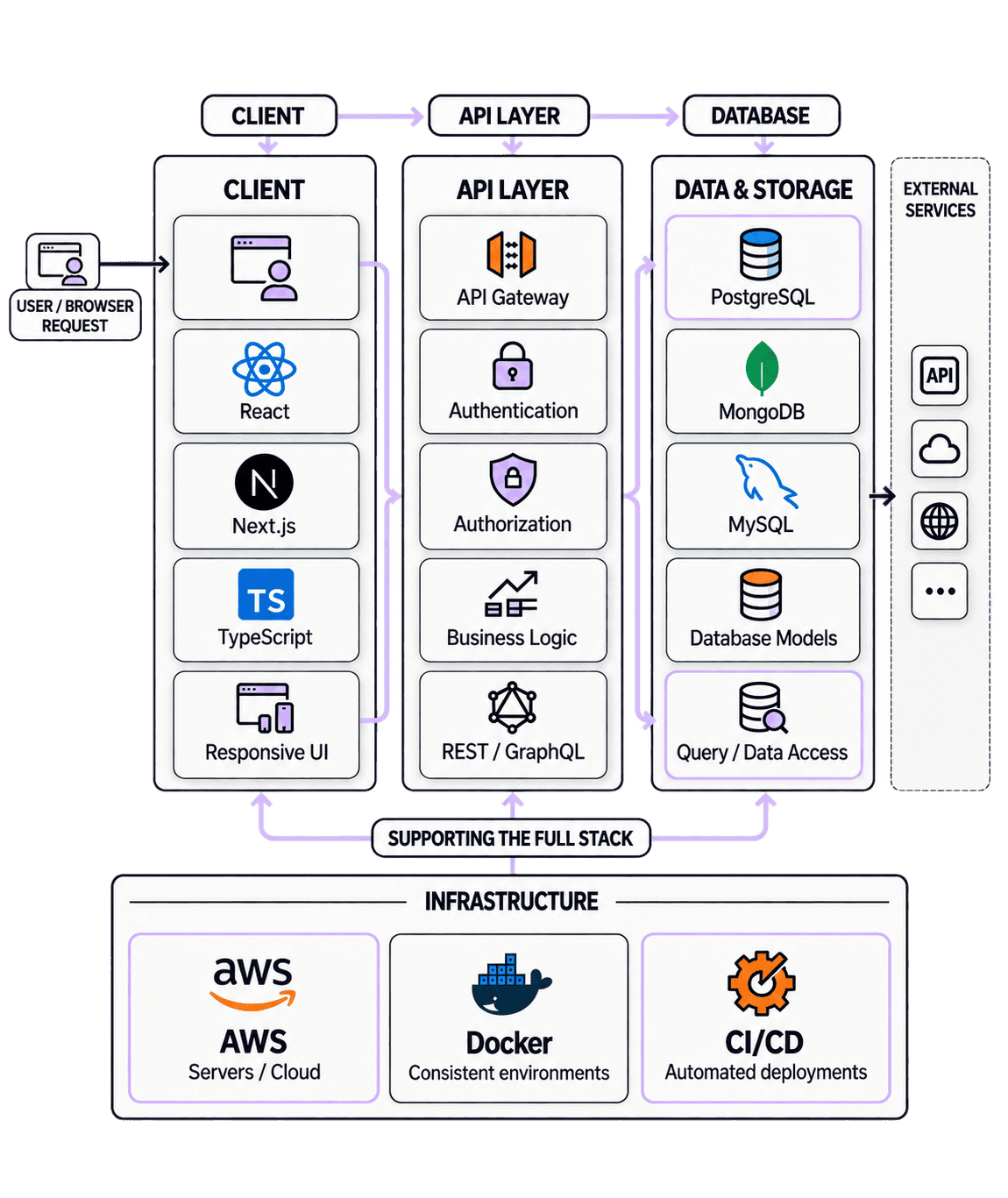
Full Stack Development system architecture architecture visualization
Full Stack Development Use Cases
Full stack development fits any business that needs a real, working app. Not just one feature. Here's where I build the most, across SaaS, dashboards, and customer-facing tools.
SaaS Products
From your first user to your thousandth, full stack development services keep the product steady as features and usage grow.
eCommerce Platforms
Storefronts, checkout, and stock tools all built with eCommerce application development in mind. Then tested under real order load.
Customer Portals
Client-facing tools for accounts, billing, or support. Built around customer portal development your users can actually use.
Marketplaces
Two-sided platforms need marketplace development that handles listings, payments, and chat, without the whole thing tangling up.
Internal Dashboards
Teams need to see their own data clearly. Dashboard development turns messy spreadsheets into one clean place to work.
MVPs for Startups
Founders testing an idea need MVP development services that ship fast. Fast, but not sloppy. Sloppy work turns into problems once you scale.
Who My Full Stack Development Services Are For
I work with all kinds of teams. From early-stage founders to companies that need something built to last. Here's who I usually work with.
Startups Building Their First Product
Need MVP application development to test an idea with real users first? This is where to start.
Growing Businesses Outgrowing Spreadsheets and No-Code Tools
Manual steps stop scaling at some point. Custom web apps and business app development replace the patchwork. With something built the way your team actually works.
Enterprises Needing Reliable, Scalable Systems
Bigger companies need enterprise web apps that meet real security and speed goals. From day one.
Companies Looking to Hire Full Stack Developers Without a Full-Time Hire
Want to hire full stack developers, or bring on remote full stack developers for one project? A freelance full stack developer gets you senior work, with no full-time cost.
What's Included in My Full Stack Development Services
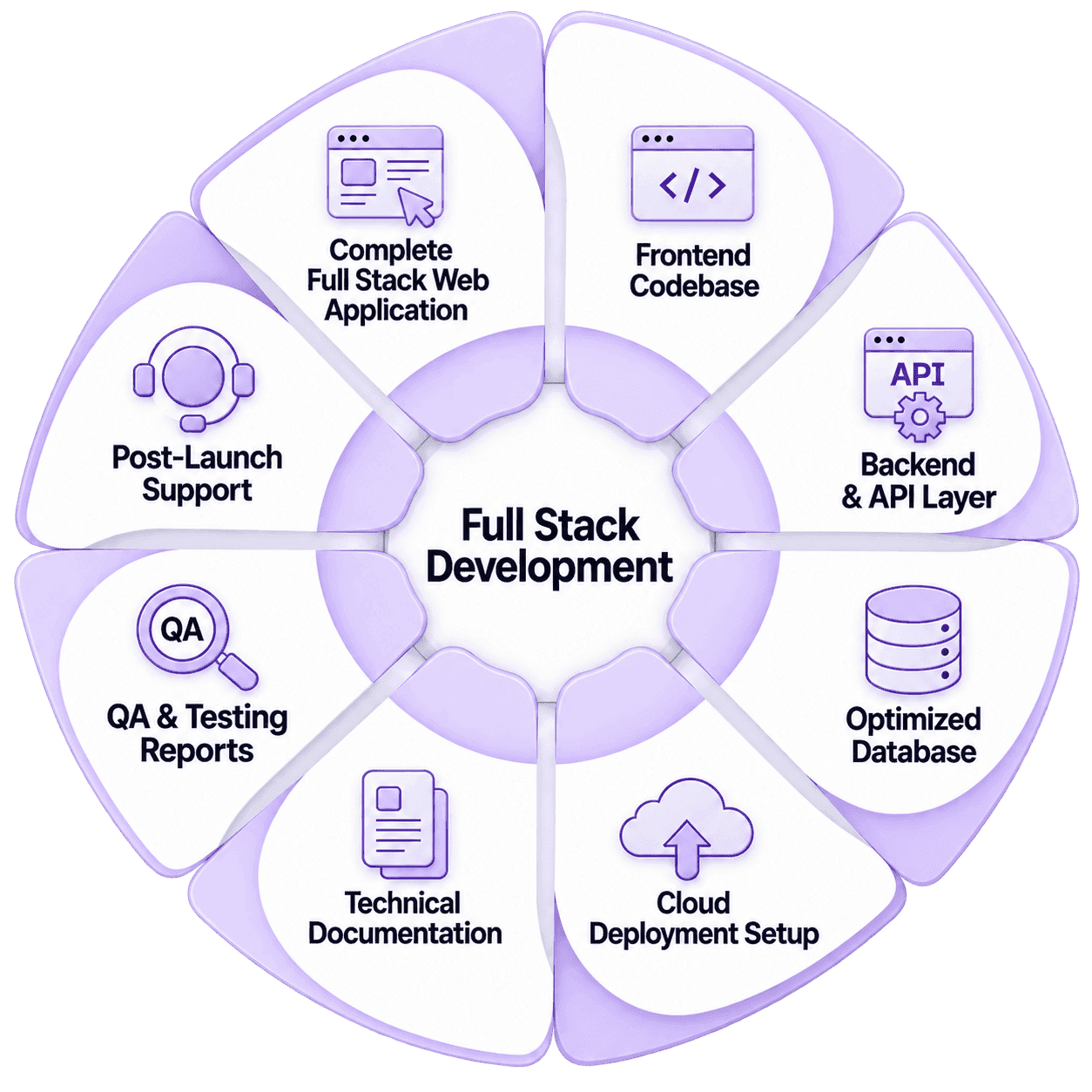
Every project ends with more than just code. Here's exactly what you get. From the live app to docs, test reports, and support after launch.
Complete Full Stack Web Application
A real, working app. Not a demo. Ready for real users on day one.
Frontend Codebase
Clean, clear React code your future team can build on.
Backend & API Layer
A working backend and API layer, with clean routes and clear docs.
Optimized Database
A schema built for your data. Tuned before launch. Not after problems show up.
Cloud Deployment Setup
Your app goes live on AWS, with alerts and monitoring set up from day one.
Technical Documentation
Clear docs, so any future developer, including you, can follow how it all works.
QA & Testing Reports
A record of what got tested, and how. So you know what you're launching with.
Post-Launch Support
Apps that stay steady under real traffic, not just in a test run.
Benefits of Full Stack Web Development
Full stack web development beats hiring two separate teams. Here are the real gains I see most, and what they lead to once your app is live.
- Benefit
Faster Delivery
One person handling frontend and backend means fewer handoffs. And fewer delays waiting on another team.
- Benefit
Consistent Architecture
One developer designs the whole system. So it stays the same, top to bottom. Not patched by different hands.
- Benefit
Lower Long-Term Costs
Compared to running an in-house team, outsourcing full stack development often costs less. While still getting you senior-level work.
- Outcome
Applications That Scale With You
Every build gets planned for growth from the start. So scale doesn't force a rebuild down the road.
- Outcome
A Better Experience for Your Users
Apps that look sharp on a phone, just as much as on a desktop.
- Outcome
Fewer Outages, More Uptime
Apps that stay steady under real traffic. Not just steady in a test run.
Why Hire Me as a Full Stack Developer?
Jay Patel full stack development services run on one idea. You should trust the person building your app to see the whole picture. I'm a certified full stack developer with real MERN stack work behind me. I bring both frontend and backend skill to every build. Not the usual one-strong-side, one-weak-side setup.
Faster Faster Full Stack Development
One engineer means fewer meetings. And faster calls, since there's no team to sync up with first.
Seamless Seamless Frontend & Backend Integration
As a full stack software engineer, I catch issues that only show up when both sides come from the same person.
End-to-End End-to-End Project Ownership
Need dedicated full stack development? You get one point of contact. Doing the work of a full team.
Clear Clear & Direct Communication
I act as a partner, not just a hired hand. Choices get explained in plain words. So you always know where things stand.
Flexible Flexible Development Support
Short project or long-term help, the setup bends to fit your real need. Not a fixed, one-size deal.
Reliable Reliable Long-Term Support
After launch, you're not on your own. The same developer who built your app keeps it running. Nothing gets lost when a project changes hands.
Experience
Years building production applications
Projects
Projects delivered across SaaS, eCommerce, and internal tools
Scope
Comfortable owning frontend, backend, and database together
Full Stack Development Projects & Examples
Reading about a process is different from seeing it applied. Here are a few full stack development projects that show how these layers come together in practice, from early planning through to a live, working application.
View Real-Time Chat Application Next.jsNode.jsTypeScriptWebSocketsReal-Time Group Chat
Real-Time Chat Application
A lightweight real-time group chat app built with WebSockets. It handles instant messaging, chat rooms, typing indicators, and seen status. The whole thing runs as a Turborepo monorepo, with a Next.js frontend and a Node.js backend. The result is a chat experience that feels fast, clean, and genuinely responsive.
- Instant rooms, typing indicators, and seen receipts, all over WebSockets
- Turborepo setup with a Next.js client and a dedicated Node.js socket server
View project
View PMS - HR Management System ReactNode.jsPostgreSQLREST APIHR Management System
PMS - HR Management System
I built a full HR platform for a mid-sized company. It covers attendance, leave requests, payroll, and role-based access. It also connects to their existing ERP system, so nothing had to be rebuilt from scratch.
- Attendance, leave, payroll, and role-based access handled in one HR cycle
- Integrated into an existing ERP system without a rewrite
View project
View MiniList - Headless CMS Next.jsNestJSTypeScriptPostgreSQLHeadless Content Management System
MiniList - Headless CMS
A full-stack headless CMS with a modern Next.js admin dashboard and a scalable NestJS backend. It handles rich text editing, blog and author management, API keys, analytics, Google OAuth, and SEO tools. A REST API sits underneath for smooth content delivery. Built on Prisma and PostgreSQL, so it stays clean, scalable, and easy to self-host.
- Next.js admin panel and NestJS API, built as a self-hostable headless CMS
- Rich text, authors, SEO fields, API keys, and Google OAuth in one place
View project
View Spendly - Expense Tracker TanStack StartReactTypeScriptSupabasePremium Personal Expense Tracker
Spendly - Expense Tracker
A personal expense tracker that turns everyday spending into a clear picture. Log an expense in seconds, set a monthly budget, and import your spending history from CSV or Excel. Totals and category breakdowns show up on one calm, private dashboard. Built with TanStack Start, React, and Supabase, with row-level security so every number stays private.
- Live dashboard with totals, six-month trends, and category charts
- CSV and Excel import with column mapping, plus one-click filtered export
View project
Full Stack Development Services FAQs
Practical answers about scope, timeline, technology, and how I work on full stack development services engagements.
Still evaluating fit?
Tell me about your product context - I'll return with honest feedback on scope and timeline.