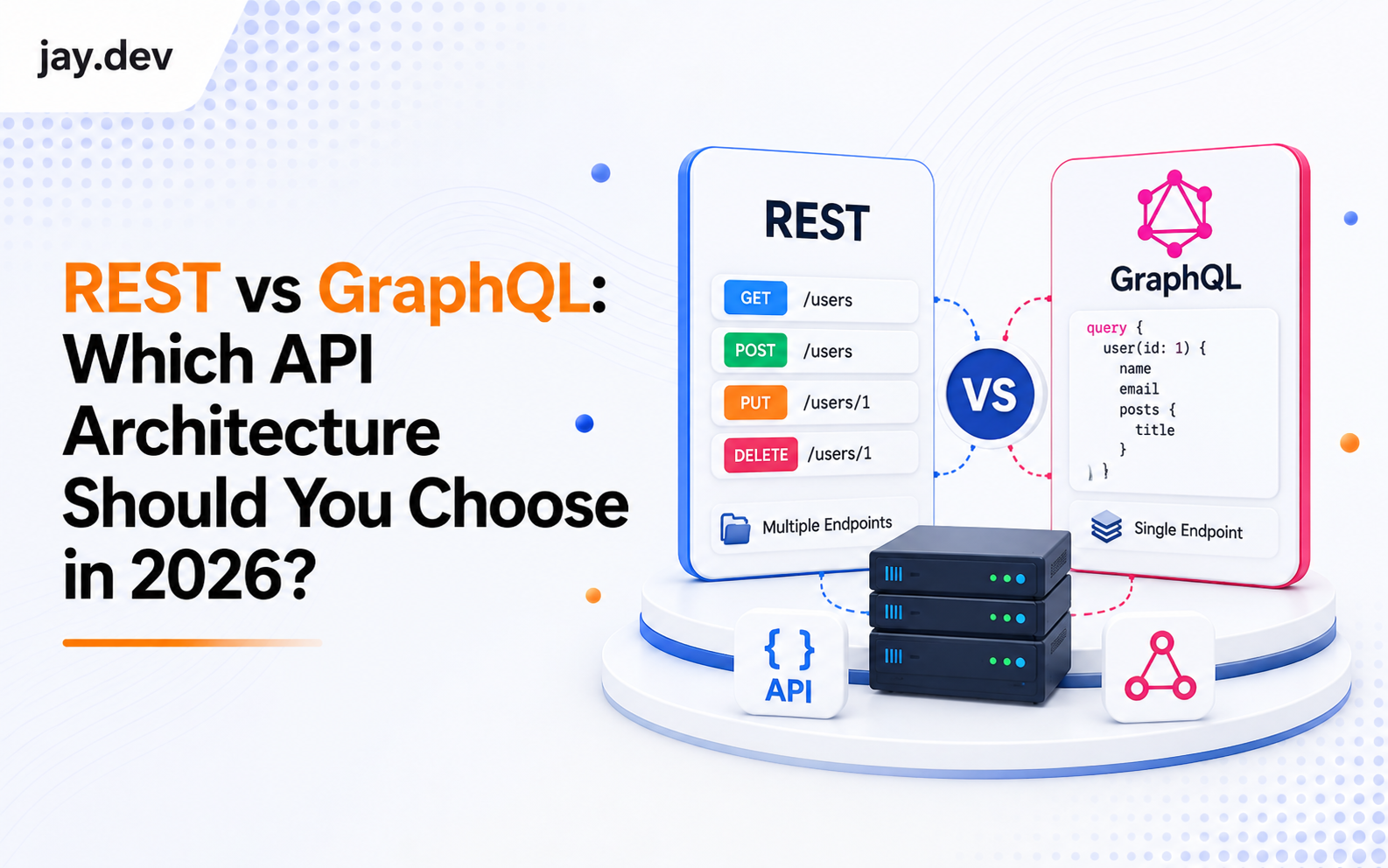
“REST vs GraphQL comes down to data shape. REST uses many fixed endpoints and gets HTTP caching for free. GraphQL uses one endpoint, so clients ask for the exact fields they need. Pick REST for simple, cacheable APIs. Pick GraphQL for connected data and many different clients”
Choosing between REST vs GraphQL is one of the first big decisions in an API project. It shapes how your frontend, backend, and database talk to each other for years. I have faced this choice on real projects, and the right answer was not the same every time.
The numbers show why people still argue about it. Postman's 2025 State of the API report surveyed more than 5,700 developers. It found that 93% of teams use REST. About 33% use GraphQL, and many of them run it next to REST. Gartner predicts that more than 60% of enterprises will use GraphQL in production by 2027, up from under 30% in 2024. So REST is still the default. GraphQL is growing fastest inside teams that already have REST.
This guide covers the REST vs GraphQL differences, performance, scalability, and pros and cons. I keep the language simple. The goal is to help you pick based on your product, not on what is trending this month.
What Is a REST API?
REST stands for Representational State Transfer. It is a style for building an API around resources. A resource is a thing like a user, a post, or an order. Each resource gets its own URL, and standard HTTP methods say what to do with it.
The methods map cleanly:
- GET reads a resource.
- POST creates a new resource.
- PUT replaces a resource.
- PATCH changes part of a resource.
- DELETE removes a resource.
REST sits directly on top of HTTP. That means browsers, proxies, and CDNs already know how to cache REST responses. You can also guess most URLs without reading any docs. These two facts are why REST has been the default choice for so long.
What Is a GraphQL API?
GraphQL is a query language and runtime for APIs. Facebook built it in 2012 and open-sourced it in 2015. Today it is governed by the GraphQL Foundation under the Linux Foundation.
A GraphQL API usually has one endpoint. The client sends a query that lists the exact fields it wants. The server returns that shape and nothing more. A schema defines every type, query, and mutation. A resolver is the function that fetches the data for each field. Clients can also use subscriptions to get live updates.
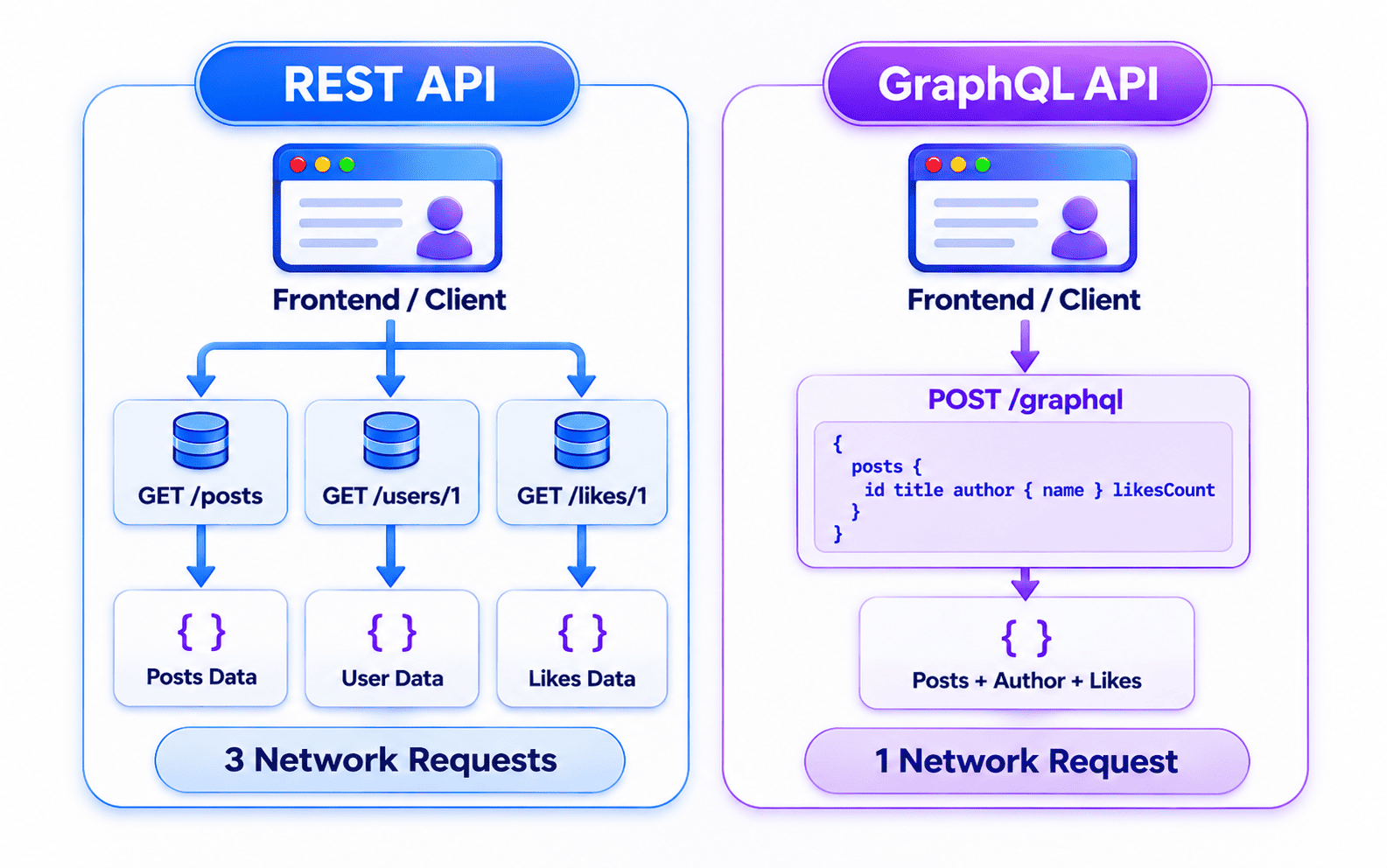
type Post { id: ID! title: String! author: User! likeCount: Int!} type Query { feed(limit: Int!): [Post!]!}With one query, a client can ask for a post, its author, and its like count in a single round trip. With REST, the same screen often needs three calls: one for posts, one for users, and one for likes.
REST vs GraphQL: Key Differences
The main REST vs GraphQL differences are about how each one shapes a request and a response.
Single endpoint vs multiple endpoints
A REST API usually has one URL for each resource type. A product with posts, comments, and users ends up with many endpoints. A GraphQL API puts everything behind one endpoint. The query decides which types and fields are used.
Over-fetching and under-fetching
These two problems shaped the design of GraphQL.
- Over-fetching means the response has more fields than the client needs. This wastes data, which hurts most on slow mobile networks.
- Under-fetching means one call is not enough. The client makes several calls to build a single screen.
GraphQL lets the client pick its fields, so it avoids both problems in one request. REST can fix them too, but usually by adding custom endpoints.
HTTP caching vs GraphQL caching
Caching is where REST has a clear edge. A GET request to a REST endpoint can be cached by browsers, proxies, and CDNs with standard headers. You write no custom code.
GraphQL normally uses POST to a single endpoint. CDNs do not cache POST requests by default. Teams often fix this with persisted queries, which turn a query into a short ID that can be sent as a GET request. Others add a cache layer inside the server or the client. If your frontend is Next.js, my guide to caching Sanity CMS in Next.js with ISR and webhooks shows the same ideas, cache layers and revalidation, in a real setup.
| Aspect | REST | GraphQL |
|---|---|---|
| Endpoints | Many, one per resource | Usually one |
| Response shape | Fixed by the server | Chosen by the client |
| HTTP caching | Works out of the box | Needs extra setup |
| Typing | Optional, often through OpenAPI | Built in through the schema |
| Learning curve | Lower for most teams | Higher, new query language |
| Requests per screen | More for related data | Fewer for related data |
REST vs GraphQL Performance and Scalability
REST vs GraphQL performance depends on the shape of your data. Neither one is fast or slow by itself.
For simple, flat resources, a cached REST endpoint is often faster. A CDN can answer the request without touching your server at all. For nested data, like a social feed with authors, likes, and comments, GraphQL often wins because it needs fewer network round trips. Each query also has extra work to do on the server, such as parsing and validating it. So GraphQL can cost more per request, even when it saves requests overall.
My advice: do not trust a generic benchmark. Test your own screens with real data and real network conditions. Then compare the total time to load one screen, not just one request.
Scalability is less about raw speed and more about how hard the system is to run. At the infrastructure level, both scale the same way. A stateless HTTP service scales by adding more servers.
The difference is cost control. In REST, each endpoint has a fairly predictable cost. In GraphQL, one query can ask for a huge amount of nested data. That is why you should add query depth limits and complexity checks before you go live.
REST vs GraphQL Pros and Cons
Every list of REST vs GraphQL pros and cons depends on the project. These points show up again and again.
REST pros
- Simple model built on HTTP methods
- Strong HTTP and CDN caching
- Huge ecosystem of tools and docs standards
- Easy for new developers to learn
REST cons
- Over-fetching and under-fetching on complex screens
- Many endpoints to version and document
- Related data can need several requests
GraphQL pros
- One flexible endpoint
- Strongly typed schema
- Clients ask for the exact fields they need
- Built-in support for real-time updates through subscriptions
GraphQL cons
- Steeper learning curve
- Caching needs extra tools
- The N+1 problem and query cost need active care
When to Use REST and When to Use GraphQL
The choice depends on two things: how connected your data is, and how many different clients use the same backend.
Web applications
A normal web app with a few screens and flat data fits REST well. It is simple, and CDN caching speeds up page loads for free. GraphQL starts to pay off when one dashboard pulls from many related resources.
Mobile apps
Mobile is where over-fetching hurts most. Every extra byte costs time on a weak connection. So REST vs GraphQL for mobile apps often leans toward GraphQL. The app can ask for a small, exact payload instead of a response built for a desktop screen.
Microservices
For microservices, it is rarely an either-or choice. Many teams keep REST between internal services because the contracts are simple and cacheable. They then put a GraphQL layer in front as a gateway. That gateway joins several services into one endpoint for clients.
SaaS and large applications
Ask how many frontends share the backend. A SaaS product may have a web app, a mobile app, and partner integrations. The more varied the clients, the stronger the case for GraphQL. Each client can request its own shape from the same schema. Your team does not need to build a custom REST endpoint for each one.
How to Choose Between REST and GraphQL: A 5-Question Checklist
If you are still stuck on REST vs GraphQL, answer these five questions. They turn a vague debate into a clear decision.
- How connected is your data? If screens need posts, authors, and comments together, lean toward GraphQL. If you serve flat lists, lean toward REST.
- How many different clients will you support? One web app is easy with REST. A web app, a mobile app, and partner tools make GraphQL more attractive.
- How much do you rely on caching? If a CDN does most of the work for you, REST keeps that benefit with no extra setup.
- What does your team already know? A team that knows REST well can ship faster with it. A new query language slows the first few sprints.
- Do you need real-time updates? GraphQL subscriptions give you a standard way to push changes. With REST, you add WebSockets or polling yourself, as I did in my real-time chat app.
Count your answers. If most point to REST, build REST. If most point to GraphQL, build GraphQL. If the answers are split, start with REST, which suits an MVP well and add a GraphQL layer later. That path costs less to reverse.
Common REST vs GraphQL Mistakes
I see the same errors again and again when teams pick one side too fast.
- Choosing GraphQL because it is newer. New does not mean better for your case. A small CRUD app rarely needs it.
- Skipping query limits. A public GraphQL endpoint without depth and complexity limits is easy to overload.
- Ignoring caching in GraphQL. Teams expect the CDN to help, and it does not, until they add persisted queries or a cache layer.
- Building too many REST endpoints. When every screen gets a custom endpoint, REST becomes hard to maintain. That is often the moment to consider GraphQL.
- Treating the choice as permanent. Both styles can live in one system. You can change your mind later.
Is GraphQL Better Than REST in 2026?
No, not in every case. And is REST still relevant in 2026? Yes, clearly. REST still powers most APIs in use today. GraphQL has grown fastest as a layer in front of existing REST and database services. It has not replaced them.
93%
developers who use REST
33%
developers who use GraphQL, often alongside REST
60%
enterprises Gartner expects to use GraphQL in production by 2027
REST vs GraphQL: Developer Experience, Security, and Documentation
Developer experience
REST has decades of tooling. You get Postman collections, OpenAPI specs, and URLs that are easy to guess. GraphQL has a different strength called introspection. A client can ask the schema what types and fields exist. That replaces a lot of manual documentation.
Security
REST security usually means protecting each endpoint and method. You check a role or token before the route handler runs.
GraphQL security focuses on the single endpoint. Depth limits, rate limits based on query cost, and permission checks inside resolvers matter most. Without a depth limit, one nested query can trigger thousands of database lookups. The OWASP GraphQL Cheat Sheet is a good place to start.
Documentation
REST docs usually live in an OpenAPI or Swagger file. Someone must update it each time an endpoint changes. GraphQL docs can come straight from the schema, so tools like GraphQL Playground and Apollo Studio stay current on their own. But a schema with no field descriptions is just as confusing as an undocumented REST endpoint. Write the descriptions.
API versioning
REST often versions through the URL, like /v1/posts and /v2/posts. It is easy to understand, but clients must move on your schedule. GraphQL usually avoids versions. You add new fields and mark old ones as deprecated. Clients keep using the same endpoint.
Can You Combine REST and GraphQL?
Yes, and this is the most common real-world path. Most teams already have a REST API. The question is whether to add GraphQL on top, not whether to tear anything out.
The usual pattern is a GraphQL gateway. You put a GraphQL layer in front of your REST endpoints and databases. Its resolvers call the existing REST endpoints. Clients only see GraphQL, and the backend stays the same underneath.
Before you add GraphQL, check for these three signs:
- Your frontend makes three or more REST calls to draw one screen.
- Web, mobile, and partner clients each want a different shape of the same data.
- Your REST responses are large, and over-fetching slows down users on weak networks.
If none of these apply, GraphQL mostly adds work without a clear payoff. As the product matures, you can revisit the decision. If you want a second pair of eyes on the client side of your API, my frontend development service covers it.
My Experience Building REST and GraphQL APIs
I build backend systems for a living, and I have shipped both styles. Here are two examples from my own work.
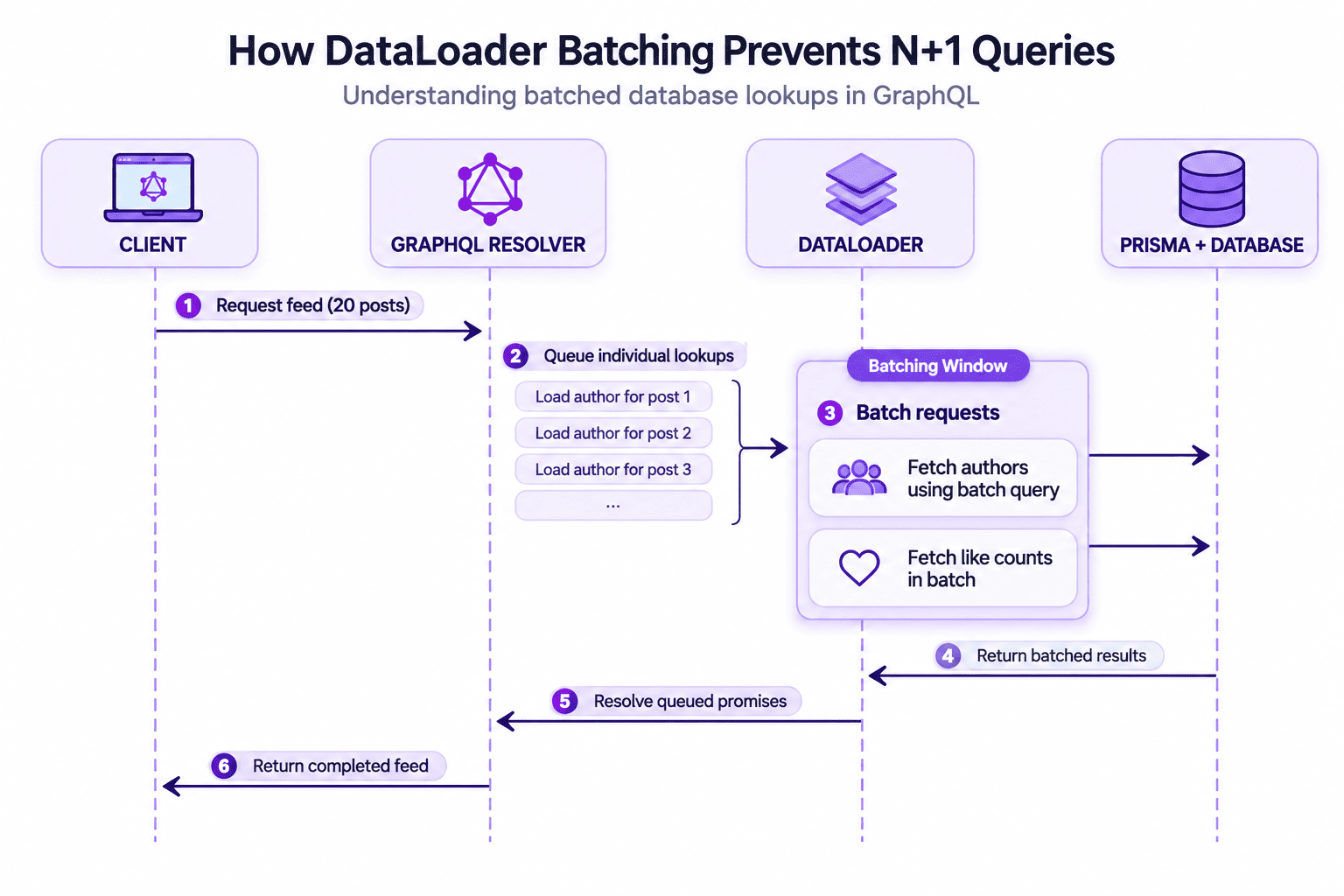
A social media backend on GraphQL. For my social media backend API, I used GraphQL with NestJS and Prisma. A feed screen needs posts, authors, and like counts together. With REST, that would mean several round trips per screen. The schema was the easy part. The hard part was the N+1 problem on the feed query. Each post triggered extra lookups until I batched them.
A headless CMS with both styles. For MiniList, my headless CMS, I exposed content through REST and GraphQL from the same service layer. This was on purpose. A simple site that lists posts calls REST and gets HTTP caching for free. An app that needs specific nested fields calls GraphQL. The cost is two surfaces to document and test. The gain is that neither kind of client has to bend to fit the other.
The lesson I took from both: pick the style that matches how your clients read data. Then plan for the downsides on day one. For GraphQL, that means batching and query limits. For REST, that means a plan for related data.
Key Takeaway
REST vs GraphQL is not about picking a permanent side. REST wins on simplicity, caching, and a predictable cost per endpoint. GraphQL wins on flexible data fetching, typed schemas and fewer requests for connected data. Start with one question: how connected is your data, and how many different clients need it? Your answer points to the right choice.
Frequently asked questions
Topics
- #REST API
- #GraphQL
- #Backend Development
- #TypeScript